
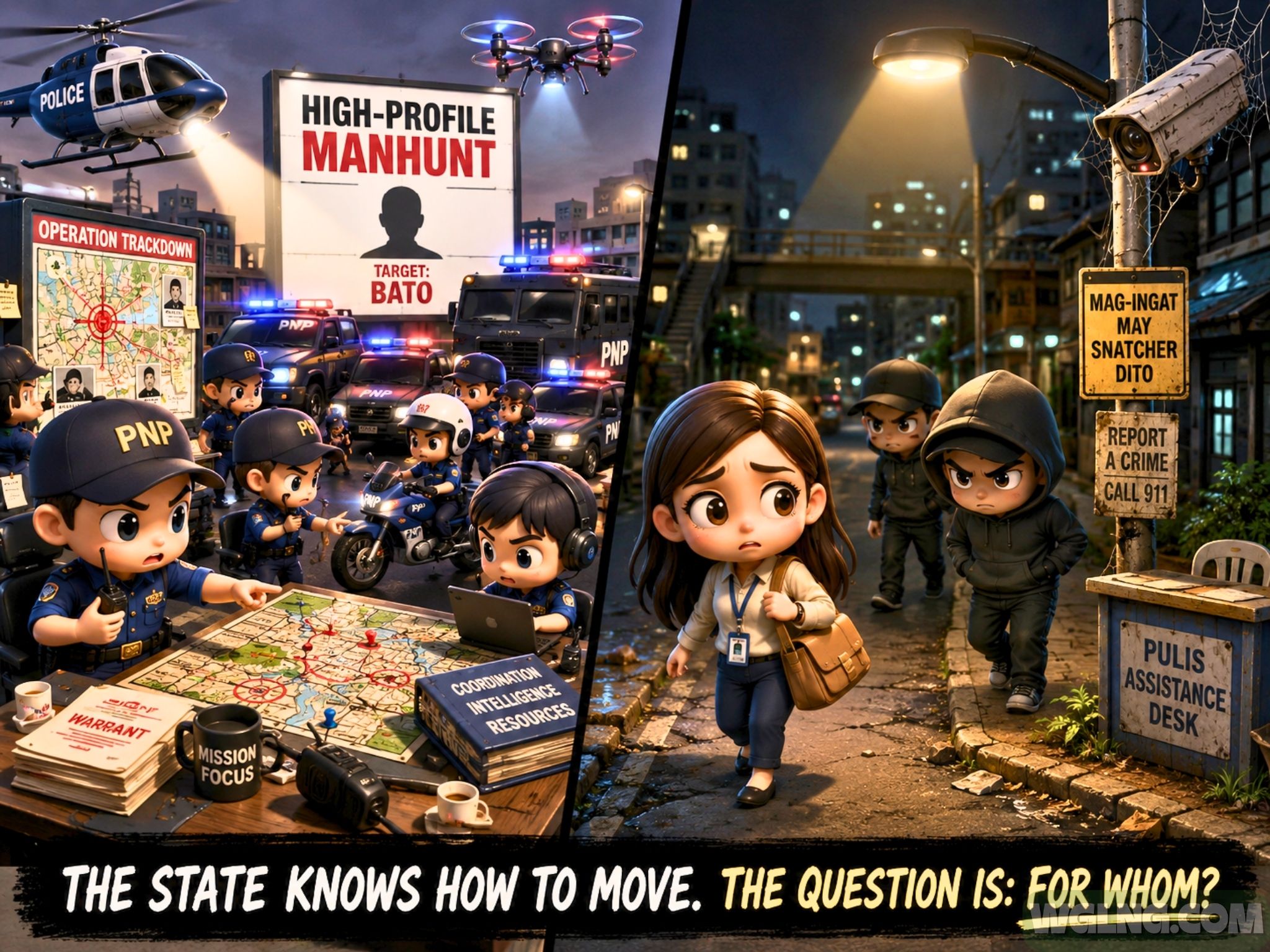
It is not that Bato dela Rosa should be left alone. If there is a warrant, if there is a legal process, and if there are serious allegations that have to be answered, then the government has reason to act. No public official should be treated as untouchable just because he is powerful, popular, or politically useful.
But ordinary Filipinos are also allowed to notice the contrast.
When the target is a politically important person, law enforcement suddenly looks awake. Tracker teams are formed. Agencies coordinate. Statements come quickly. Operations are mounted. Everyone seems to know what to do.
Then people look at their own streets.
The footbridges where commuters get robbed. The alleys workers avoid after dark. The jeepney stops where people hold their phones and bags a little tighter. The neighborhoods where residents know who the troublemakers are, but do not really expect help to arrive before something bad happens.
Crime statistics may show improvement, at least, according to the government. But public safety is not only about numbers on a chart. It is also about whether people actually feel protected in ordinary places.
This is not to say every police officer has stopped doing street duty just to chase one man. That would be unfair, and too easy to dispute. The government can pursue a high-profile legal case and still protect ordinary citizens.
But does it feel that way? For many people, no.
The sovereignty issue makes the question even sharper. Many Filipinos are already uneasy about the ICC’s role in our national affairs. Whether one agrees with the ICC or not, it is fair to ask why our government appears so visibly responsive to an international legal process while ordinary people still feel exposed to criminals in their own communities.
Again, this is not a plea to ignore Bato. It is a question of priorities.
Law enforcement will always have to choose where to place its attention. That is understood. But those choices become harder to accept when people feel least protected in the places where they are most vulnerable: streets, transport stops, markets, footbridges, and neighborhoods.
Ordinary Filipinos should not feel like extras in a drama about powerful people. They are the ones walking home, closing shops, waiting for rides, crossing dark streets, and hoping nothing happens.
So yes, pursue the powerful when the law requires it. But do not make people wonder why the state seems strongest when the world is watching, and least present when they are simply trying to get home.