
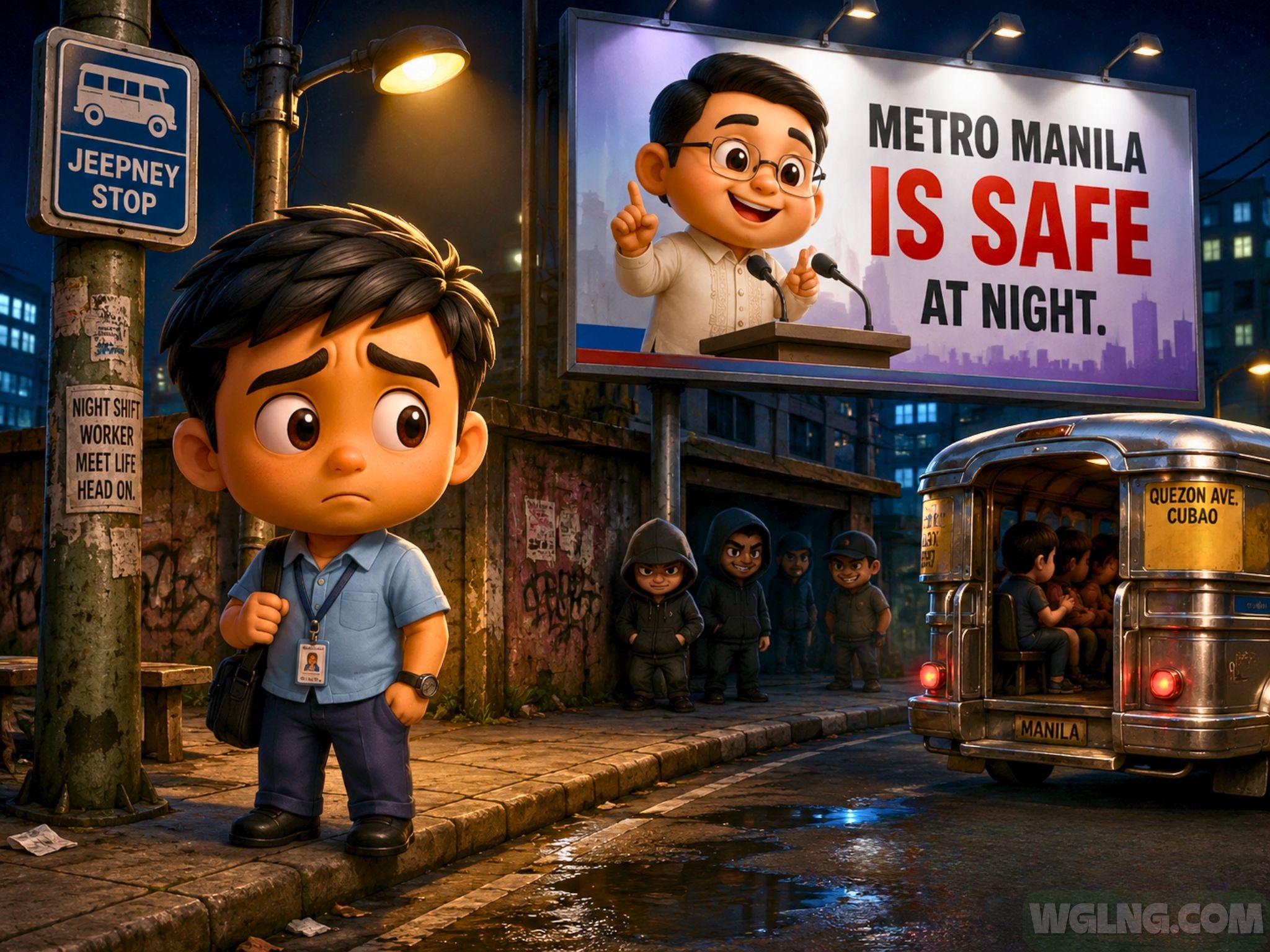
During Duterte’s presidency, my wife and I rented an apartment in one of those Quezon City neighborhoods where you learned to keep your guard up. Filipinos know the kind. Narrow streets. Mostly low-income families. A few lower-middle-class homes here and there. The sort of place where you learned to keep your head down, walk quickly, and avoid unnecessary trips outside after dark.
Before Duterte’s drug war, I would not have dared walk around that area at night. Even daytime carried a certain unease. Muggings were common enough to become part of the neighborhood’s background noise. There were also reports of innocent civilians being killed by petty criminals who, according to residents and news accounts, were either under the influence of illegal drugs or involved in the drug trade.
Then the drug war happened.
Almost overnight, or at least that was how it felt, the neighborhood changed. The streets became quieter. The sense of menace receded. Residents seemed to reclaim public spaces that had long felt surrendered to fear. People could walk outside at night again. They could run errands, wait for transportation, or simply stand by the street without looking over their shoulders every few seconds.
That was not an abstract policy debate to me. I worked the night shift. I had to leave the apartment when most people were already asleep and take public transportation across Metro Manila. During that period, I felt safer doing so than I had before. That was my lived experience, and I know many people from similar neighborhoods understood exactly what that meant.
But that side of the story was never allowed to stand on its own.
In much of the public conversation, the drug war was reduced to one narrative: state violence, abuse, and human rights violations. Those issues deserved scrutiny, of course. Any campaign that involves police operations, deaths, and state power should be questioned. But what was harder to accept was how one-sided the moral outrage often became.
People killed in police operations were repeatedly presented as victims of a cruel system. Meanwhile, ordinary citizens victimized by drug-linked crimes were often treated as background material, if they were mentioned at all. Their names disappeared quickly. Their families rarely became symbols. Their deaths did not generate the same sustained indignation from the loudest voices in media, politics, and so-called civil society.
That imbalance is what many people resent.
It is not that ordinary Filipinos are incapable of understanding human rights. It is that they also understand fear. They understand what it means to live beside a troublemaker everyone knows but no one can confront. They understand what it means to avoid certain alleys, to rush home before dark, to worry about a child walking back from school, or to hear that another neighbor was robbed, stabbed, or killed.
For many comfortable observers, crime is a statistic. For people in vulnerable communities, it is a daily negotiation with danger.
And now, years after Duterte left office, the old anxieties seem to have returned. In the neighborhood where we once lived, reports of muggings and killings have again become familiar. Whether one agrees with Duterte or not, it is difficult to deny that many communities once felt a kind of order return during his presidency — and that many of those same communities now feel exposed again.
The powerful do not experience this fear the same way. They move around in private vehicles. They live behind gates. They have guards, drivers, connections, and distance. They do not have to wait for a jeepney on a dark corner. They do not have to walk past the same group of men loitering by the street every night. They do not have to wonder whether the person approaching them is merely asking for directions or looking for a victim.
That is why the lectures often ring hollow.
When government officials or elite commentators insist that the streets are safe, one wonders: safe for whom? Safe from the back seat of an SUV? Safe inside a guarded subdivision? Safe from a press briefing, a panel discussion, or an air-conditioned office far removed from the streets they claim to understand?
The poor and lower-middle class do not have the luxury of debating public safety as an intellectual exercise. They live with the consequences of policy failure. They pay for disorder with their wallets, their fear, their mobility, and sometimes their lives.
This is the part of the drug war discussion that many people still refuse to confront. The campaign may have had excesses. It may have had abuses. It may have raised serious questions that should never be brushed aside. But it also existed in response to a real and terrifying problem that polite society often preferred to discuss only when it could be used against Duterte.
The victims of crime deserve moral attention, too.
The mothers who lost children to drug-crazed criminals deserve outrage, too.
The workers walking home at midnight deserve protection, too.
The communities that felt safer, however briefly, deserve to be heard without being mocked, dismissed, or treated as morally inferior.
My wife and I no longer live in that neighborhood, but the memory has stayed with me. I remember what it felt like before. I remember what changed. And I remember how quickly the people who never had to live there presumed to explain what the rest of us were supposed to feel.
That, perhaps, is the real divide. Not simply between pro-Duterte and anti-Duterte. Not even between left and right. But between those who discuss public safety from a distance, and those who have had to measure it one dark street at a time.
And when the people who felt safest under the old disorder start lecturing the people who feared it most, one begins to understand why so many Filipinos no longer trust the moral language of the powerful.