
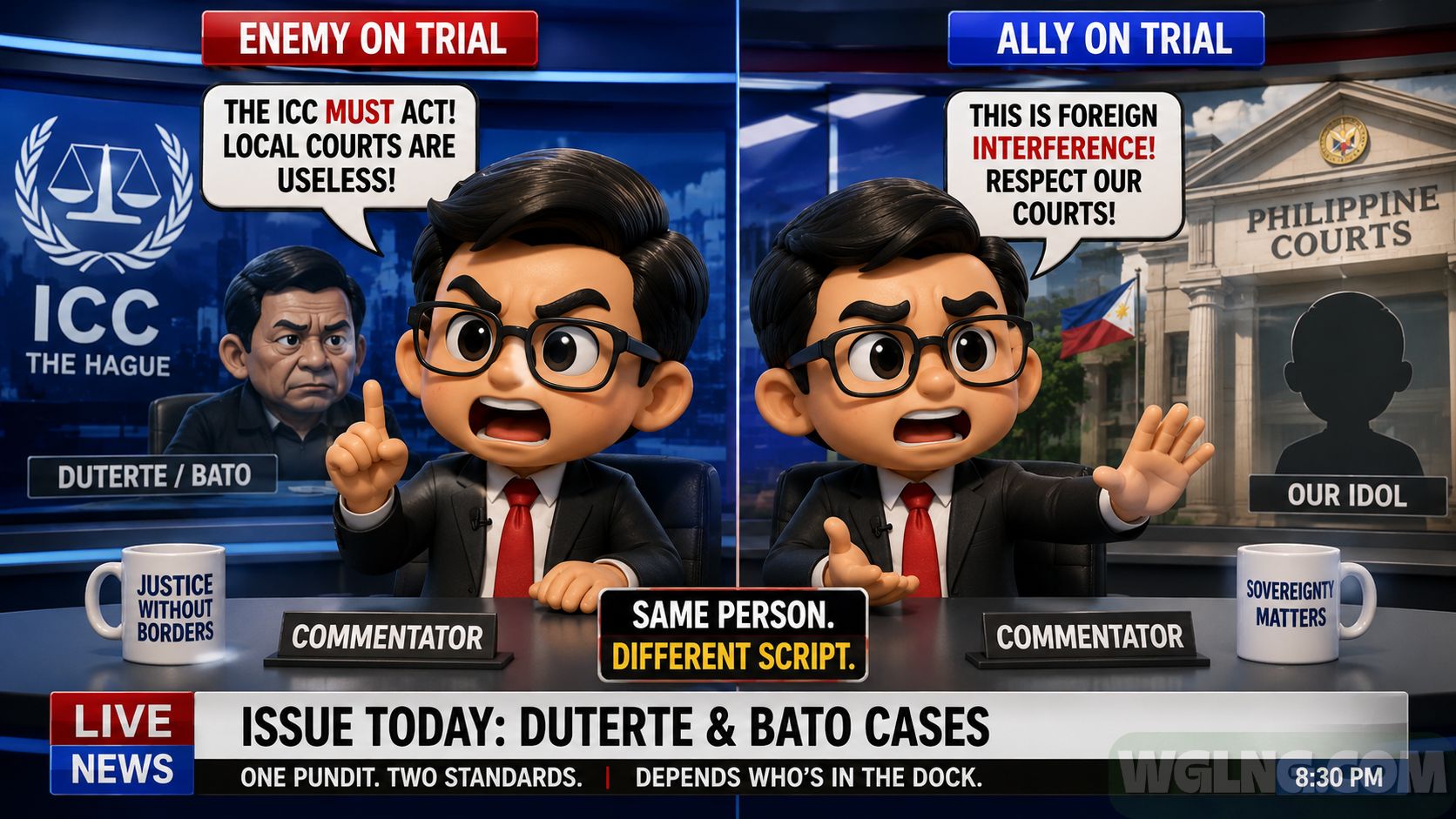
Let me be honest. I’m no legal expert. I don’t speak in ICC statutes or sovereign immunity clauses. But I’ve been watching what’s happening with Rodrigo Duterte and now Senator Bato Dela Rosa, and something doesn’t sit right.
This isn’t really about the drug war anymore, or even about the International Criminal Court. To me, it feels like we’re being tested on whether we actually believe in anything—or whether we just pick whichever argument helps us win the fight of the day.
For years, people who hated Duterte said the same thing: we need the ICC because our own courts won’t do the job. They said Philippine justice is too weak, too scared, too compromised to go after someone like him. So The Hague becomes the only option. That’s the argument. Clean, simple, easy to remember.
But here’s where I get confused.
A lot of those same people—the ones cheering Duterte being sent to The Hague—I wonder if they’d keep that same energy if the ICC went after their own political heroes. Suddenly, I bet sovereignty wouldn’t sound like a dirty word anymore. Suddenly, Philippine courts would matter. Due process would be sacred. The very same people who said “our justice system is a joke” would start talking about national dignity the second their favorite leader was in the crosshairs.
That doesn’t sound like principle to me. That sounds like picking whatever court hurts your enemy and protects your friend.
When Duterte was handed over to the ICC, his enemies called it accountability. Finally, no one is above the law. But his supporters saw something else: our own government—with its own Constitution, its own courts, its own Congress, its own Supreme Court—cooperating with a foreign court to go after a former president. That stings, whether you like Duterte or not.
Now Bato Dela Rosa is in the spotlight. He was Duterte’s police chief during the drug war, and now he’s a sitting senator. And here’s where the contradiction gets really sharp.
If we truly believe the Philippines is a sovereign country with a working justice system, then Bato should be tried here, not abroad. Full stop. But if we believe our courts are useless—but only when it comes to people we don’t like—then sovereignty becomes conditional. It only exists when we need it as a shield.
That’s dangerous, isn’t it?
Because a court system can’t be respected only when it gives us the verdict we want. Either we think Philippine courts can go after powerful people, or we don’t. Either the ICC is a legitimate backstop when our own system fails, or it’s foreign interference. What we can’t do—honestly, at least—is flip-flop depending on whose neck is on the line.
That’s why I’ve started calling this “jurisdictional opportunism.” It’s people who are Hague-first when the accused is their enemy, but Philippines-first when the accused is their idol. They don’t really stand for the rule of law, or sovereignty, or human rights as fixed ideas. They just stand for winning.
Now, let me be fair. There are sincere people who support the ICC because they genuinely believe the victims of the drug war will never get justice here. That’s a real position, and it deserves to be heard.
But there are also people who just use “international justice” as a weapon. For them, the ICC isn’t about the rule of law. It’s about finding the most convenient court to punish the other side.
What the Duterte and Bato cases really show, I think, is a deeper sickness in our politics. Principles get treated like costumes. Sovereignty is worn when it protects your allies. International accountability is worn when it punishes your enemies. Due process is holy when it helps you, and a joke when it gets in your way.
That’s not justice.
That’s just politics dressed up in a judge’s robe.