
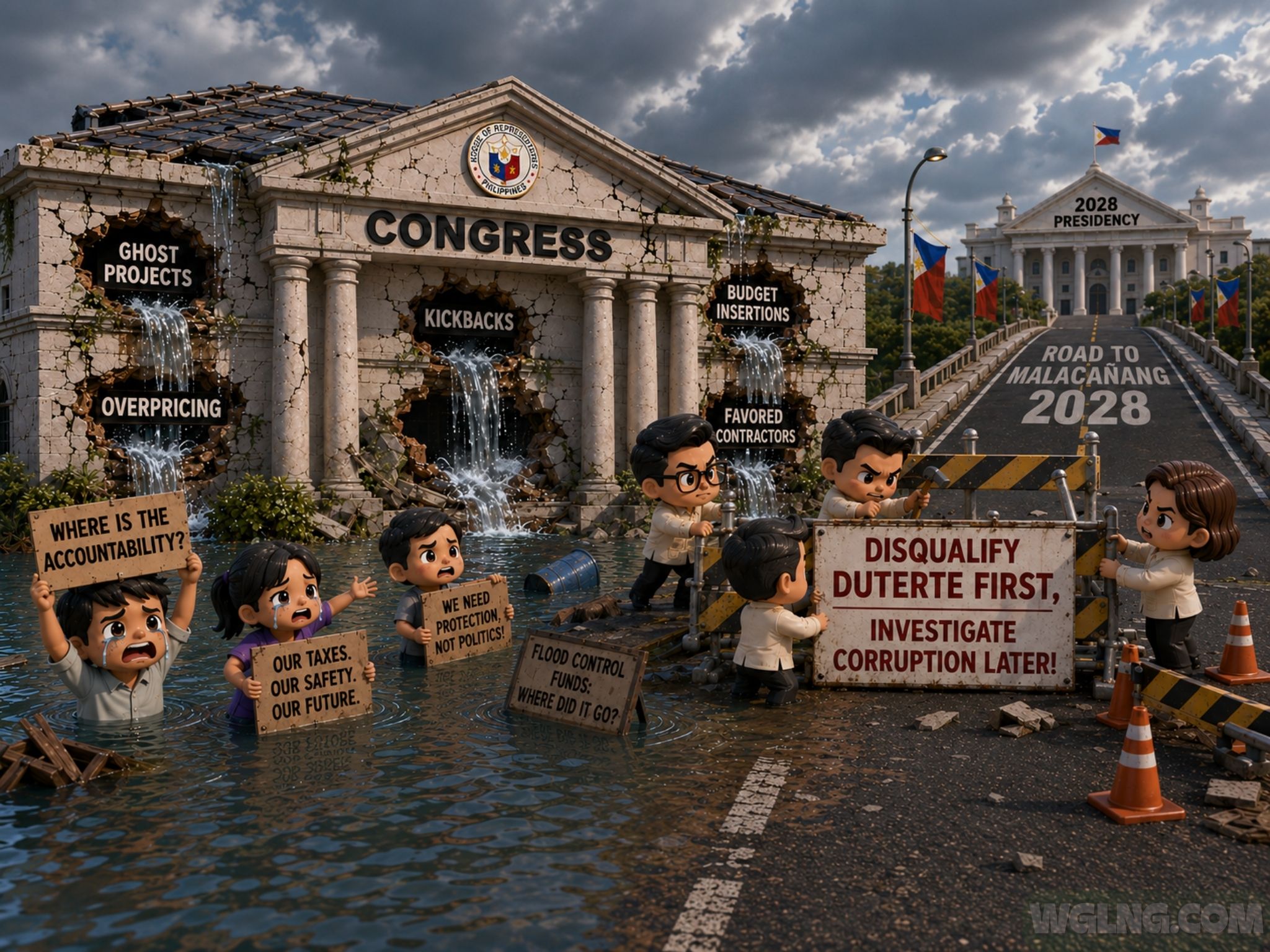
There is something deeply revealing about how quickly political institutions can move when the target is useful.
For months, the Philippines has been gripped by the flood-control corruption scandal: billions in public funds, questionable infrastructure projects, allegations of ghost or substandard work, and the familiar stench of public money being siphoned away while ordinary Filipinos are left to suffer the consequences. This is not an abstract scandal. Flood control is not a luxury project. It is supposed to protect homes, roads, schools, livelihoods, and lives.
And yet, just as the public was beginning to demand answers about who benefited, who approved the projects, who inserted the funds, who signed the contracts, and who protected the network, Congress seems to have discovered a new object of intense urgency: the impeachment of Vice President Sara Duterte.
That shift says a lot.
It says that Congress can move fast when it wants to. It says lawmakers can find discipline, numbers, coordination, and political will when the issue is a high-stakes power struggle. It says the machinery of government is not slow by nature. It is slow only when the victims are ordinary Filipinos and the suspects may include too many well-connected names.
The flood-control scandal should have been a moment of national reckoning. It should have forced a serious examination of how infrastructure funds are planned, inserted, awarded, inspected, and liquidated. It should have led to a relentless pursuit not only of engineers and regional officials, but of contractors, political patrons, budget sponsors, and lawmakers who may have had a hand in turning disaster-prevention projects into private income streams.
Instead, the energy appears to have shifted.
And the shift is difficult to ignore.
Sara Duterte’s impeachment may involve serious allegations. No public official, including the vice president, should be placed beyond accountability. If public funds were misused, if threats were made, if constitutional violations occurred, then those accusations deserve to be examined through the proper legal and constitutional process. This is not about defending Sara Duterte. It is not about excusing her. It is not about choosing one political dynasty over another.
The point is simpler than that: corruption should be pursued no matter who committed it.
That is exactly why Congress’s sudden intensity looks so selective.
If lawmakers can summon overwhelming force to pursue impeachment because it may stop Sara Duterte’s planned presidential run in 2028, then why can they not summon the same force to expose everyone involved in the flood-control mess? Why is there no comparable urgency to identify the full chain of responsibility behind projects that may have robbed communities of protection from flooding? Why does the system seem more determined to neutralize one political threat than to dismantle a corruption pipeline?
The answer may be uncomfortable, but it is not surprising.
Congress is not merely a lawmaking body. It is also a fortress of political interests. Many of its members belong to the same ecosystem that benefits from the status quo: dynasties, patronage networks, budget insertions, favored contractors, transactional alliances, and election-time calculations. In that world, corruption is not always treated as a moral emergency. Sometimes, it is treated as a management problem. A scandal becomes dangerous only when it threatens the wrong people, at the wrong time, in the wrong political configuration.
That is the double standard.
When corruption is diffuse, systemic, and potentially implicates a broad network of insiders, the process becomes slow, technical, fragmented, and buried in hearings. But when the target is a political rival whose removal could reshape the 2028 presidential race, suddenly Congress becomes focused. Suddenly the numbers are there. Suddenly the moral language becomes loud.
This is why many Filipinos are cynical.
They have seen this pattern before. Accountability is invoked not as a consistent principle, but as a weapon. Corruption is condemned, but often selectively. Public outrage is welcomed when it can be steered toward a convenient enemy, but it becomes inconvenient when it points toward the deeper machinery that keeps the same political class in power.
That machinery is the real problem.
The flood-control scandal is not just about broken projects. It is about a broken order. It is about a political culture where public works can become private opportunity, where oversight often arrives only after the damage is done, and where accountability stops at a manageable level before it reaches the truly powerful.
If Congress is serious about corruption, then the test is obvious: pursue both.
Pursue Sara Duterte if the evidence warrants it. But pursue the flood-control scandal with the same fury. Follow the money. Name the contractors. Expose the budget sponsors. Investigate the lawmakers. Audit the projects. Prosecute the fixers. Jail the guilty, whether they are engineers, mayors, representatives, senators, Cabinet officials, allies, enemies, or donors.
Anything less is political theater.
The Filipino people do not need Congress to prove that it can destroy a political rival. They already know politicians are good at that. What they need is proof that Congress can confront corruption even when doing so threatens its own comfort, allies, and financial networks.
Right now, the message is grim.
Congress appears more animated by the need to manage the 2028 presidential battlefield than by the need to confront a corruption scandal that directly harmed the public. It appears more committed to preserving the political order than to cleaning it. It appears more interested in deciding who gets to inherit power than in asking who stole from the people.
That is not accountability.
That is the status quo defending itself.