CHISA’s expressive reactions and clever narration turn a simple eating video into something surprisingly fun.

I did not expect to enjoy a video of someone eating this much. But here we are.

XG dropped a CHISA mukbang, and it was honestly more entertaining than I thought it would be. A mukbang, for those who do not follow this corner of internet culture, is basically a video where someone eats on camera while talking, reacting, or turning the meal into a little performance.

With Chisa, that setup already has an advantage.

She is just naturally funny. Not in a forced, “please laugh now” kind of way. More like she reacts so openly that the comedy comes out on its own. One moment she is confident, the next she looks like she is questioning her life choices, and then she keeps going anyway.

What really helped the video, though, was the narration-style commentary. It made the whole thing feel like a serious documentary about a food challenge that was not serious at all. That contrast worked. A bite became a moment. A pause became suspense. Suddenly, it was not just Chisa eating. It became a tiny quest.

Then came the surprise twists.

Whether those twists affected the final “achievement” is for viewers to decide. Maybe the challenge was still clean. Maybe it was slightly compromised. Maybe the twists only made the whole thing funnier.

For me, they made it better.

This is the kind of side content I enjoy from XG because it lets the members breathe a little. We already know they can perform. We already know they can own a stage. But lighter videos like this show another part of the appeal: their personalities are strong enough to carry even the simplest ideas.

In this case, Chisa turned a mukbang into a small comedy event.

Watch the video: https://www.youtube.com/watch?v=PSRhEZK6Tys


Categories The XG File, The Entertainment Margins

The government can pursue legal accountability, but it should not leave ordinary people wondering why protection feels distant where they live and commute.

It is not that Bato dela Rosa should be left alone. If there is a warrant, if there is a legal process, and if there are serious allegations that have to be answered, then the government has reason to act. No public official should be treated as untouchable just because he is powerful, popular, or politically useful.

But ordinary Filipinos are also allowed to notice the contrast.

When the target is a politically important person, law enforcement suddenly looks awake. Tracker teams are formed. Agencies coordinate. Statements come quickly. Operations are mounted. Everyone seems to know what to do.

Then people look at their own streets.

The footbridges where commuters get robbed. The alleys workers avoid after dark. The jeepney stops where people hold their phones and bags a little tighter. The neighborhoods where residents know who the troublemakers are, but do not really expect help to arrive before something bad happens.

Crime statistics may show improvement, at least, according to the government. But public safety is not only about numbers on a chart. It is also about whether people actually feel protected in ordinary places.

This is not to say every police officer has stopped doing street duty just to chase one man. That would be unfair, and too easy to dispute. The government can pursue a high-profile legal case and still protect ordinary citizens.

But does it feel that way? For many people, no.

The sovereignty issue makes the question even sharper. Many Filipinos are already uneasy about the ICC’s role in our national affairs. Whether one agrees with the ICC or not, it is fair to ask why our government appears so visibly responsive to an international legal process while ordinary people still feel exposed to criminals in their own communities.

Again, this is not a plea to ignore Bato. It is a question of priorities.

Law enforcement will always have to choose where to place its attention. That is understood. But those choices become harder to accept when people feel least protected in the places where they are most vulnerable: streets, transport stops, markets, footbridges, and neighborhoods.

Ordinary Filipinos should not feel like extras in a drama about powerful people. They are the ones walking home, closing shops, waiting for rides, crossing dark streets, and hoping nothing happens.

So yes, pursue the powerful when the law requires it. But do not make people wonder why the state seems strongest when the world is watching, and least present when they are simply trying to get home.


Categories Civic Exhaustion, Selective Justice

Remote participation has a place in real emergencies, but it should not become a shortcut for lawmakers who do not want to face the floor.

Let me say this upfront: this is not about taking the side of one Senate bloc over another. I am not cheering for the minority just because they happen to oppose the majority on this issue.

My problem is bigger than today’s numbers.

I do not want any bloc, now or later, to turn remote participation into a convenience pass.

Remote participation already exists for emergencies. The Senate rules already allow sessions through teleconference, video conference, or other reliable electronic means when there is force majeure or a national emergency — the kind of situation where the Senate cannot meet physically, or senators cannot be there in person.

That makes sense. Government should not grind to a halt during a pandemic, a major disaster, or an actual emergency.

But that is not what this moment looks like.

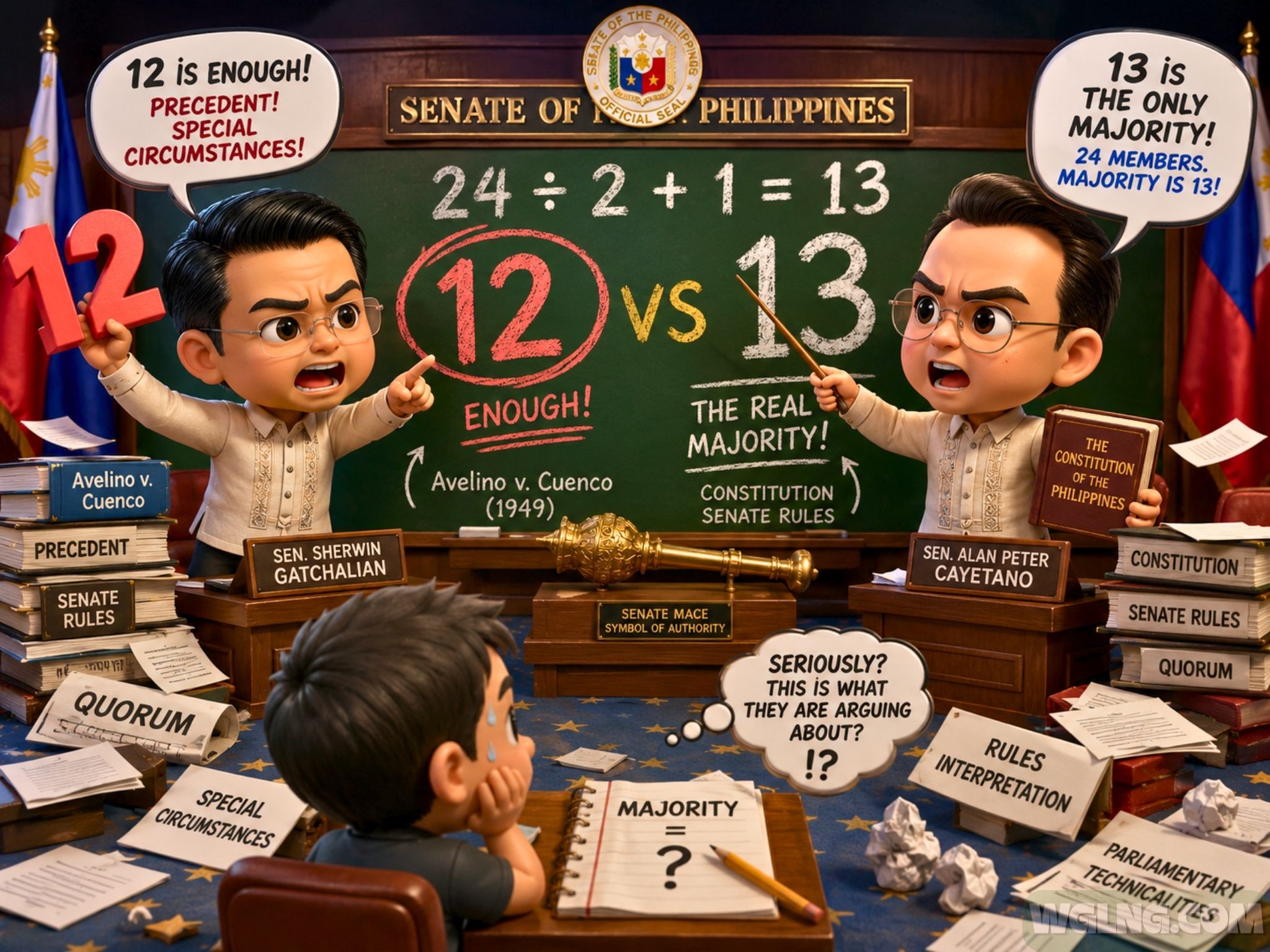
What we have now is a Senate in turmoil: a fragile majority, a minority walkout, questions over quorum, and growing suspicion that this rule change could benefit senators who are absent, under legal pressure, or politically useful from a distance.

So no, this is not just about Zoom links.

It is about whether senators who are not on the floor should still be counted, heard, and allowed to vote while the chamber is fighting over numbers and control.

That is where the danger begins.

Because once this door is opened too casually, it will not only matter who benefits today. It will matter who abuses it tomorrow. A senator avoiding pressure. A bloc trying to preserve numbers. A convenient vote appearing from somewhere off-camera. An absence made useful.

That should worry us.

The Senate floor is not just a counting room. It is where senators are supposed to show up, face each other, get challenged, get interrupted, defend their positions, and be seen by the public they claim to represent.

Physical presence still matters. Not because we are allergic to technology, but because democracy should involve some exposure. Some discomfort. Some accountability.

Modernize the Senate, sure. But do not modernize it into absentee lawmaking.

Remote participation has its place in real emergencies. It should not become an everyday shortcut, especially under today’s political cloud.

Senators were elected to represent the people.

Outside genuine emergencies, the least they can do is show up.


Categories Civic Exhaustion, Procedural Farce

Invited as guests rather than performers, XG still carried themselves on the AMAs red carpet like a group ready for a bigger American spotlight. (L-R: Harvey, Hinata, Juria, Jurin, Chisa, Cocona, and Maya.)
Invited as guests rather than performers, XG still carried themselves on the AMAs red carpet like a group ready for a bigger American spotlight. (L-R: Harvey, Hinata, Juria, Jurin, Chisa, Cocona, and Maya.) Photo credits: Billboard.com

I have been an XG fan since their 2022 debut, so seeing Jurin, Chisa, Hinata, Harvey, Juria, Maya, and Cocona walk the red carpet at the American Music Awards felt quietly emotional.

They were not nominated. They were not there to perform. From what I understand, they were invited guests; there to grace the show, meet the press, pose for photos, and be seen by a wider American entertainment audience. And honestly, I am more than fine with that.

For a group like XG, whose ambitions have always pointed beyond one market, simply being in that room matters. This was not a trophy moment. It was a visibility moment. And sometimes, visibility is the first door that opens before everything else follows.

What made me happiest was seeing U.S. media give them time, even if briefly. Billboard interviewed them on the red carpet, where they talked about being excited to see KATSEYE, meeting the Jonas Brothers, and their current world tour. Entertainment Tonight also caught them on the carpet. Entertainment Weekly and WWD included them in their red-carpet coverage. CBS and AMAs social posts highlighted their look, even playfully calling it an “X-Gala.”

That may seem like a small ripple to people outside the fandom. But to fans who have watched them grow from “Tippy Toes” onward, it means something. A photo gallery here, a quick interview there, a social clip with their name on it — those are the small points of contact that make unfamiliar viewers pause and ask, “Who are they?”

And of course, XG looked the part. Their styling had that familiar XG balance: sharp, futuristic, fashion-forward, a little intimidating, but still playful. Each member had her own presence, but together they looked like a unit with a clear identity. Not guests who accidentally wandered onto the carpet, but artists who belonged there.

I know XG wants to make it big in North America. I hope this AMAs appearance becomes one of those early markers fans look back on later and say, “That was when more people started noticing.”

And with the U.S. leg of their current world tour, I hope this moment brings them even more attention, more fans, and more success.

Sources / Footnote


Categories The XG File, The Entertainment Margins

While senators fight over factions and future elections, Filipinos keep waiting for action on wages, prices, transport, healthcare, flooding, and corruption.

The Senate, in Theory and in Shame

I understand why a Senate exists. At least in theory.

A second chamber is supposed to check the House, scrutinize the executive, improve legislation, and stop bad laws from being rushed through. In a functioning democracy, that role matters.

But looking at the Philippine Senate now, it is hard not to feel disgusted.

Too much of the chamber seems swallowed up by political self-preservation. We have seen the leadership drama involving Alan Peter Cayetano replacing Tito Sotto. We saw the attempt to place Ronald “Bato” dela Rosa under Senate protective custody amid the ICC warrant controversy. We are watching the continuing power struggle around Vice President Sara Duterte’s impeachment trial. And now there is the controversy involving Rodante Marcoleta, who is reportedly facing plunder and indirect bribery complaints before the Ombudsman.

Dela Rosa remains wanted by the ICC over alleged crimes against humanity tied to the Duterte drug war, while Philippine authorities have said they are seeking his arrest.

While Politicians Posture, Filipinos Wait

These are not small things. And taken together, they do not look like isolated controversies. They look like a Senate busy protecting factions, shielding allies, settling scores, and preparing for the next national election cycle. Whether every move is directly about 2028 or not, the behavior certainly feels like pre-campaign warfare.

And while they posture, ordinary Filipinos wait.

They wait for serious oversight of public spending. They wait for accountability in infrastructure and procurement. They wait for real work on healthcare, food prices, wages, public transportation, disaster preparedness, education, water supply, flooding, and garbage management.

They wait for a government that treats daily suffering as urgent, not as background noise.

That is what makes this spectacle so insulting. The Senate is not cheap. It is powerful. Its members are elected nationally and given enormous visibility. Yet too often, that power seems to be spent on protecting allies, attacking enemies, rehearsing campaign narratives, and keeping political families relevant.

When a Check Becomes a Cartel

To be fair, I am not saying “abolish the Senate tomorrow.” That would be too easy, and maybe too careless. A second chamber can be useful. In a country where the presidency and the House can also be captured by dynasties and factions, checks and balances are not something we should casually throw away.

But when the supposed check becomes another cartel of ambition, people have every right to ask what it is still good for.

If senators cannot put the people first, if they cannot stop turning the chamber into a staging ground for 2028, if they cannot do the work they were elected and paid to do, then Filipinos should seriously ask whether this version of the Senate still deserves its place in our democracy.

Because right now, it does not look like the Senate is serving the people.

It looks like the people are being made to serve the Senate.


Categories Oligarchic Theater, Procedural Farce