
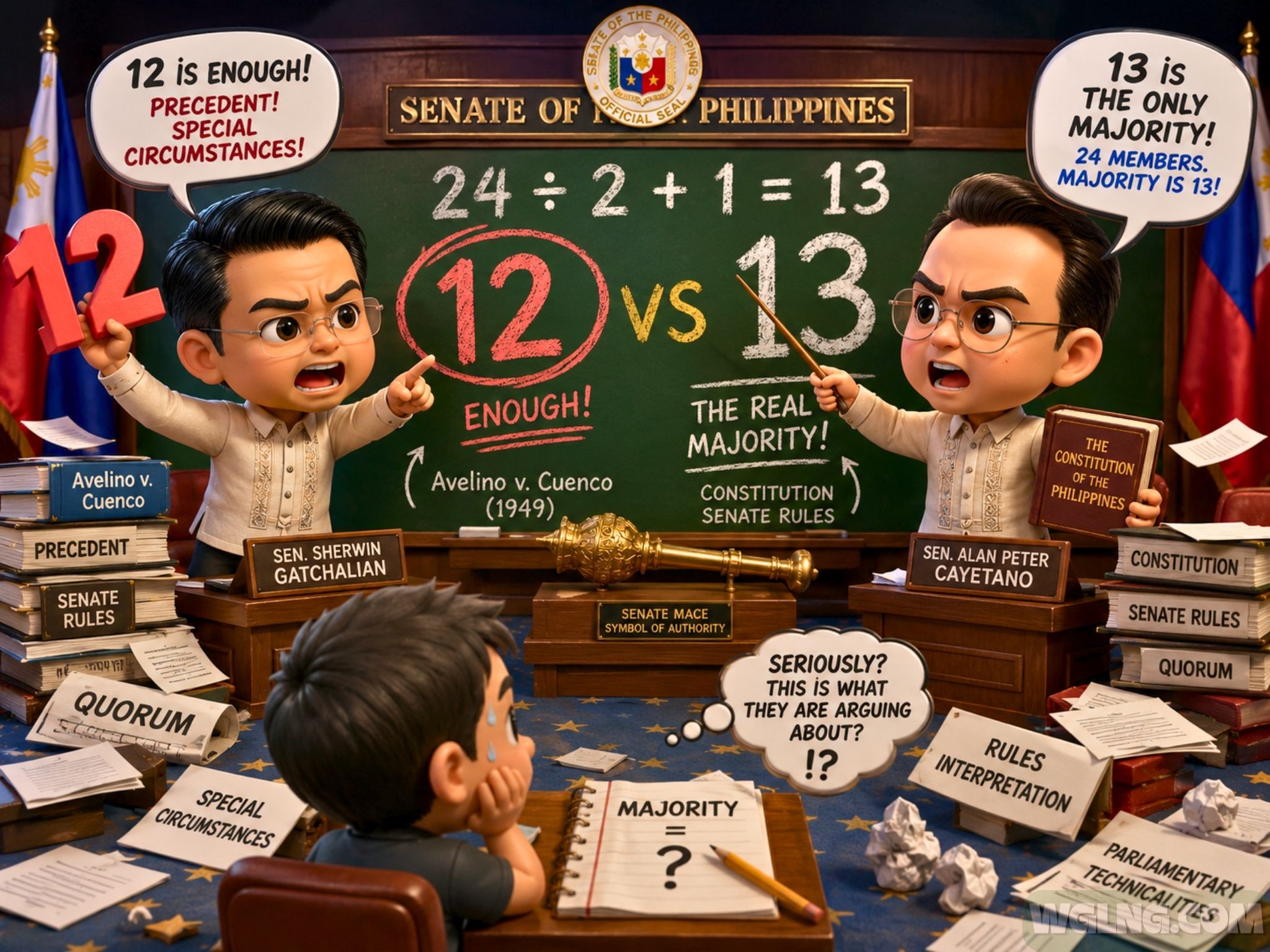
How far will educated, powerful people go just to protect their interests? Apparently, very far.
Far enough to turn a question of numbers into a constitutional drama. Far enough to make the public sit through serious-sounding arguments over whether 12 can somehow function like 13, whether absence changes the meaning of majority, and whether a Supreme Court case from 1949 can suddenly become useful again at exactly the right political moment.
That is where we are with this latest Senate mess.
A 24-member chamber is now arguing over whether 12 senators can validly act as the majority. One side points to Avelino v. Cuenco and says there is precedent for it under special circumstances. The other side says this should not be complicated: if there are 24 senators, then the majority is 13.
Both sides can sound clever, of course. They can cite rules, precedents, cases, traditions, and principles. They can make the whole thing sound noble if they try hard enough.
But from the outside, it looks less like a defense of constitutional order and more like power politics wearing a lawyer’s coat.
That is the thing about politics. Self-interest is almost never introduced as self-interest. It gets a nicer name. Institutional reform. Respect for precedent. Fidelity to the rules. Defense of the Senate. Protection of democracy. Pick one.
And maybe there are real legal questions somewhere in all that. I am not dismissing that entirely. But it is hard not to see the simpler fight underneath: who controls the floor, who controls the committees, who controls the agenda, and who gets the better position for the next political battle.
If this feels absurd, it is not even new.
Philippine Senate history has already given us the almost cartoonish image of politicians fighting over the Senate mace.
The mace is supposed to be a symbol of institutional authority. A dignified object. A ceremonial marker that the chamber is properly constituted and ready to act. But in the middle of a power struggle, even that can become a prop. At one point in our political history, control of the mace became entangled with the question of who had the legitimate Senate majority.
Just think about that for a moment.
Grown adults. Educated officials. Powerful people. Treating a ceremonial object as if holding it could help settle who had the real authority in the chamber.
It would be funny if it were not so embarrassing. It is 2026 and nothing has changed.
But maybe that is the calculation. When power is the prize, embarrassment becomes bearable. Looking ridiculous becomes acceptable. Public ridicule becomes just another cost of doing business. Loyalists will defend them. Allies will explain things away. The public will eventually get tired, or distracted, or overwhelmed by the next scandal.
And in the meantime, the institution takes another hit.
Every twisted argument, every procedural ambush, every walkout, every sudden appeal to principle teaches the public the same ugly lesson: rules look sacred only when they are useful. Once they become inconvenient, even “great minds” can find a way to bend them.
That is the most frustrating part. They do not always look and act stupid because they are stupid. They look and act stupid because they think YOU are.