
Clean-As-You-Go sounds simple enough, but in practice, it often disappears the moment customers stand up.

One small frustration I keep running into in fast-food and casual dining places is the unbussed table.

I was at a popular cake shop with an eat-in section during a hectic lunch hour. After paying for my order and waiting for the food to be prepared, I found an empty table for two.

Empty, yes. Clean, no.

The previous customers had left their plates and utensils behind, as if the table stopped being their concern the moment they stood up. Clean-As-You-Go, at least in that moment, was clearly not part of the arrangement.

I stood there briefly, hoping one of the staff would notice. Some were obviously busy. A few, at least from where I was standing, did not appear occupied. Still, no one came.

So I gathered the plates and utensils myself and started bringing them to the counter. Only then did one of the staff suddenly move, grab his cleaning tools, and rush to the table.

I do sympathize with service workers. I really do. Many of them are certainly underpaid, overworked, and expected to stay pleasant through rush-hour pressure. A lot of us in the working class know what that feels like. Maybe part of the problem is understaffing. Maybe part of it is low pay. Maybe it is the usual story of businesses squeezing labor while expecting workers to absorb the consequences.

But sympathy does not erase the job. Tables still need to be cleared. Customers should not have to make the problem visible before the system starts moving.

And customers are not blameless either. In many fast-food spaces here, Clean-As-You-Go still does not seem deeply ingrained. Too many people leave their mess behind because someone else is technically paid to deal with it.

That, to me, is the real annoyance. Everyone has a piece of responsibility here. Customers should not leave a table looking abandoned. Staff should still keep the dining area usable. Owners should not run these places so thinly that basic cleanliness becomes a game of chance.

My only consolation was the food. The fried chicken was good. The side noodles were good.

The table, unfortunately, had a longer story to tell.


Categories Cultural Alienation, Public Nuisance Studies

Every scandal burns hot for a few days, until the machinery around power quietly buries what the public was never meant to keep watching.

I have long given up hoping that the Filipino government will one day wake up, shape up, and remember that it exists to serve the people.

That sounds cynical, I know. But how else should ordinary citizens feel after watching the same cycle repeat itself for years? Scandal erupts. Billions are mentioned. Hearings are called. Names are floated. Public anger rises. Then, slowly and conveniently, the story is buried under a new spectacle, a new feud, a new outrage manufactured just in time to make everyone forget the last one.

Now we are being asked to accept another grand political drama: the possible removal or disqualification of a leading 2028 contender before the people even get the chance to decide. Supporters will call it accountability. Opponents will call it political manipulation. But to those of us watching from the outside, it has the familiar smell of power protecting itself.

What makes it unbearable is not only the maneuvering. It is the lack of shame.

These are people who advertise their education, their credentials, their international exposure, their law degrees, their supposed devotion to democracy. Yet when the moment calls for statesmanship, what we get is brute political appetite. No finesse. No restraint. No sense that the country is already exhausted.

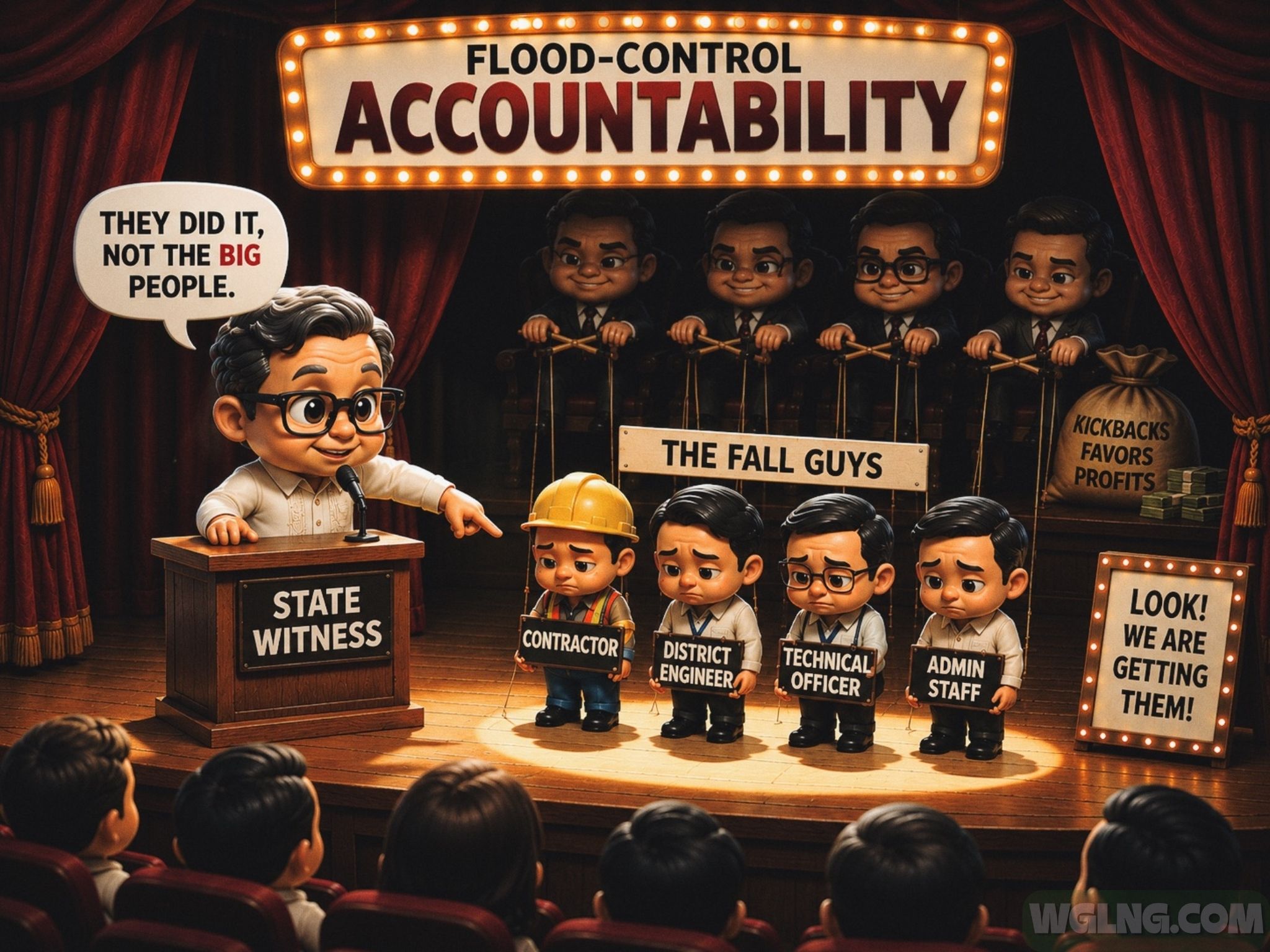
Meanwhile, the flood-control scandal and other stories of alleged plunder should have shaken the Republic to its foundations. If billions meant for public protection can vanish while communities drown, that should be enough to paralyze the machinery of government with shame.

But it did not.

Why would it? The powerful know the rhythm. Let the headlines burn for a few days. Let the usual personalities perform outrage. Then let friendly institutions, useful commentators, and a distracted media ecosystem do the slow work of disposal. Not unlike an accomplice tasked with hiding the bodies after the crime, the system knows how to bury what it does not want the public to keep looking at.

And us Filipino masses? We are told to vote better, hope harder, understand the process, respect institutions, and wait for justice. But how many times can a people be told to wait while the political, business, and media oligarchy feast on public money and drive ordinary citizens face first into the ground?

At some point, resignation becomes its own national tragedy.

What should the Filipino masses do now? I honestly do not know. But I know this: accepting hopelessness as normal is exactly what the powerful are counting on.


Categories Civic Exhaustion, Oligarchic Theater

The former XGALX chief received a suspended sentence in Japan, leaving the legal matter clearer but his professional future far less certain.

Simon Who?

For casual followers of XG, the name Simon may not immediately ring a bell. For ALPHAZ, it does.

Simon, also known as JAKOPS, is Junho Sakai, the former XGALX chief and longtime creative figure closely associated with XG’s formation, sound, image, and mythology. For years, he was not just some background executive whose name sat quietly in the credits. He was part of the story fans were told about XG — the architect figure, the one who helped shape the group before the world knew who Jurin, Chisa, Hinata, Harvey, Juria, Maya, and Cocona would become onstage.

That is why his legal trouble was never going to feel like a small side item.

Back in February, Simon was arrested in Japan in connection with a drug case involving cocaine. Reports said the incident was tied to a hotel in Aichi Prefecture, around the time XG had been in Nagoya for the Japan leg of their second world tour. Japanese and international reports at the time identified him as XG’s producer and said cocaine and suspected cannabis were found in the room. The matter later narrowed into a charge involving cocaine use.

After the case became public, Simon apologized. He said XG’s members were not involved and were not at fault. He also announced that he was resigning as company representative. That distinction mattered then, and it still matters now. Whatever people think of Simon, the group members should not be made to carry the moral weight of an adult executive’s actions.

Now we have the court decision.

The Court Decision!

On June 1, the Tokyo District Court handed Simon a guilty verdict: one year and four months of imprisonment, suspended for three years.

That means he was convicted, and the prison sentence is real on paper. But he does not serve the jail time immediately. The sentence is suspended. If he stays out of qualifying legal trouble during the three-year suspension period, he avoids prison for this case. If he reoffends and the suspension is revoked, that prison sentence can come back into play.

To many people, that will sound light. And honestly, from an ordinary person’s gut-level view, it is easy to see why. Cocaine use is not a parking violation. Japan is known for being strict with drugs. For someone connected to a high-profile act, and one with young fans and global brand ambitions, “convicted but no immediate jail time” can feel like a soft landing.

But there is also the legal side. For a first-time personal-use type drug conviction, especially with an admission of guilt, remorse, and a defense argument built around treatment and low risk of reoffending, a suspended sentence does not appear to be shocking in the Japanese legal context. Prosecutors had sought one year and six months. The court gave one year and four months, suspended for three years.

So yes, it can feel light. But it may not be legally unusual. The more interesting question is what happens outside the courtroom.

A suspended sentence keeps Simon out of prison for now. It does not automatically restore his position, his credibility, or the trust of the people who once placed professional confidence in him. That is the harder part. Courts deal in charges, evidence, sentences, and conditions. The entertainment industry deals in something more fragile: reputation.

And reputation is not restored by technicalities.

Can Simon Redeem Himself?

It may be too early, and frankly too presumptuous, to declare that Simon is finished in the industry. I do not know what people inside Avex, XGALX, or the Japanese entertainment community truly think. I do not know who still believes in him privately, who feels betrayed, who is willing to give him another chance, or who has already closed the door.

But from the outside, it is hard to imagine an easy path back.

Entertainment is built on trust: trust from artists, staff, labels, sponsors, venues, media, and fans. In XG’s case, that trust is even more delicate because the group is not simply another act moving through the usual pop machinery. XG has been carefully built as a global project, with a distinct identity, a loyal fanbase, and rising international visibility. Anything that threatens that momentum will be treated seriously.

Simon may have avoided immediate jail time. That is one thing. Avoiding professional exile is another.

There is also a difference between being legally allowed to move forward and being welcomed back into the same room with the same authority. The law may say he has a chance to rebuild. The industry may quietly decide that the risk is too high. Both things can be true.

For XG fans, the cleanest position remains the same: support XG, do not blame the members, and be honest about what happened. Simon was important to the XG story. That cannot be erased. But importance is not immunity.

If anything, the sentencing closes one chapter and opens a more uncomfortable one. The court has spoken. Now comes the longer judgment — the one made by colleagues, partners, sponsors, and the public.

That judgment may take far longer than three years.

News Sources:


Categories The XG File, The Entertainment Margins

A reflection on why I pay for the ALPHAZ app, what I actually value from it, and why fandom should never become a spending contest.

What’s even the point of telling people I pay for the ALPHAZ app? I’ve asked myself that too. It’s a slightly awkward thing to announce; like I’m holding up a receipt for my devotion. But that’s not what this is. Paying for a fan app doesn’t make someone a better fan, and not paying doesn’t make anyone less of an ALPHAZ.

Fandom should never be a spending contest.

Still, I’ve been a paid member of the ALPHAZ app for over two years now. I’m on the Annual/Standard plan. There is a higher tier, the Annual/Premium, but I’ve drawn my own line. I keep renewing for a simpler reason: it feels like one small, direct way to support a group I’ve followed since their 2022 debut.

Why I Pay

Let’s start with the obvious perks.

The app gives members behind-the-scenes clips, member posts, photos, diaries, and smaller updates that don’t always make it to the XG public feed. For fans who like seeing the quieter, more casual side of XG, that already has its own quiet charm.

It’s not always grand content. Sometimes it’s just a bunch of photos, a short message, a casual check-in, or a glimpse of the members being themselves away from the stage lights. But that’s part of the appeal. The app feels like a slightly more official corner of the fandom, separate from the noise of public social media.

The Perk That Matters Most to Me

My favorite part of the membership isn’t the photos or the diaries. It’s the ability to enter early raffles for seats and tickets to Japan-based shows.

As someone who has traveled to Japan to see XG live, that matters. It’s not a guarantee—a raffle is still a raffle. But having an earlier lane, a better shot, or at least a more organized path to applying for tickets is valuable. For overseas fans, any bit of structure helps.

The content is fun, yes. But the early ticket access is what really keeps me renewing.

Support Doesn’t Have to Be Grand

I’m not saying every fan should immediately buy an annual membership. That can be a real stretch depending on where you live, your exchange rate, and whatever else you’re already paying for in life. But maybe the monthly option is worth considering. Even just once.

For some fans, support means buying albums or going to shows. For others, it means streaming, posting, subscribing for a month, or simply showing up when XG drops something new. None of those things, alone, carries a career. But together? Fan support matters.

It helps sustain the momentum XG has been building from the get-go. It signals to the company that there’s an audience willing to show up. It tells the members their work isn’t disappearing into the void.

That’s why I pay for the ALPHAZ app. Not because I think it grants me special fan status. It doesn’t. I pay because I can, because I genuinely enjoy what comes with it, and because it feels like one small, honest way to stand behind a group that has given me a lot of joy.

If you’ve been an ALPHAZ from the sidelines, maybe consider stepping inside the app. Even for a month.

You might find it feels less like a paywall and more like a small, official home for this fandom.


Categories The XG File, The Entertainment Margins

When powerful voices rush to defend violent criminals, ordinary citizens are left wondering who is supposed to defend them.

I saw an article about a Thames Valley Police officer shooting a drug-crazed, knife-wielding man inside a railway station.

Good job, I say. Not because a shooting is something to cheer about. It is not. Not because police should be handed a blank check. They should not. But a man with a knife inside a public railway station is not a theoretical problem. It is not a neat little debate for people safe behind microphones, press releases, and committee tables.

It is a threat. Right there. Right then. And in that moment, the job of the police is to protect the public.

That is what bothers me about where we are now.

Would a police officer in my own city still have the nerve to act that decisively? Or would he pause, knowing what comes next? The suspect is armed. The public is in danger. Someone could be stabbed. But the moment the officer uses force, the familiar machinery starts moving.

Politicians posture. Human rights groups issue statements. Outspoken congressmen and senators suddenly find their outrage. And somehow, the officer who stopped the threat becomes the one dragged through the mud.

Dismissal. Prosecution. Public humiliation. All because he dared lay a finger on someone endangering everyone around him.

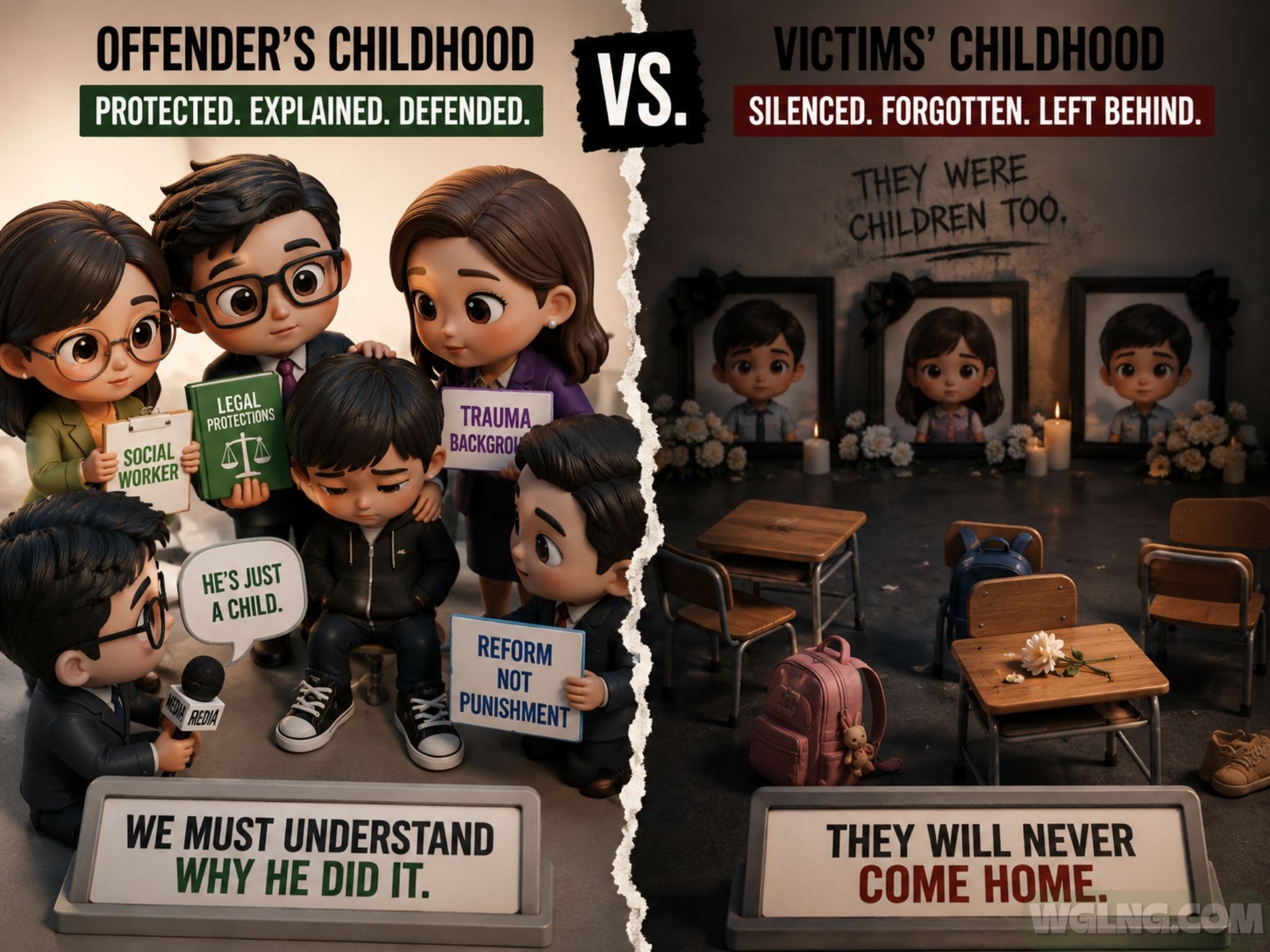
Meanwhile, the ordinary citizen is told to wait: Wait for the investigation. Wait for due process. Wait for careful language about the suspect’s rights, background, trauma, poverty, addiction, and whatever else can soften the image of a violent offender.

Fine. Discuss those things.

But where is that same careful concern for the victim?

Where is the urgency for the commuter who could have been stabbed? For the shopkeeper robbed by someone high and desperate? For the family terrorized in their own neighborhood? For the ordinary person who does not have a lawyer, a senator, a press conference, or an advocacy group ready to speak for him?

That is the part that enrages me.

Too many powerful voices seem far more energetic when defending the criminals than when defending the public. They roar when the criminal is hurt. They mumble when the victim is buried, traumatized, or left to fend for himself.

And at some point, we have to stop pretending this has no consequences.

When violent drug offenders are constantly treated as people to be rescued from accountability, what message does that send? When every police action is treated as brutality before the facts are complete, what does that do to the officers who are supposed to protect us?

Who benefits from that hesitation? Certainly not the ordinary citizen.

I am not saying every suspect should be shot. I am not saying police abuse should be excused. Any officer who brutalizes the innocent, plants evidence, or uses the uniform as a license for cruelty should face the full force of the law.

But stopping an armed attacker in a public place is not abuse. That distinction matters.

A knife-wielding assailant is not the moral center of the story just because he can be described with words like poverty, trauma, addiction, or social injustice. Those things may explain parts of a life. They do not erase the danger he creates when he threatens people with a weapon.

The public is the moral center of the story. The victims are. The people trying to get home alive are.

That Thames Valley officer saw a threat and acted before innocent people paid the price. That should not be controversial.

So why does it feel controversial here?

I do not want lawless policing. I want a country where police can act decisively against an immediate public threat without being politically destroyed for doing their job. I want a society that can defend human rights without coddling violent criminals.

And I want to know why the people who are always loudest for drug offenders are so often quietest when ordinary citizens become their victims. The people who keep mistaking coddling for compassion know exactly who they are.


Categories Civic Exhaustion, Selective Justice