
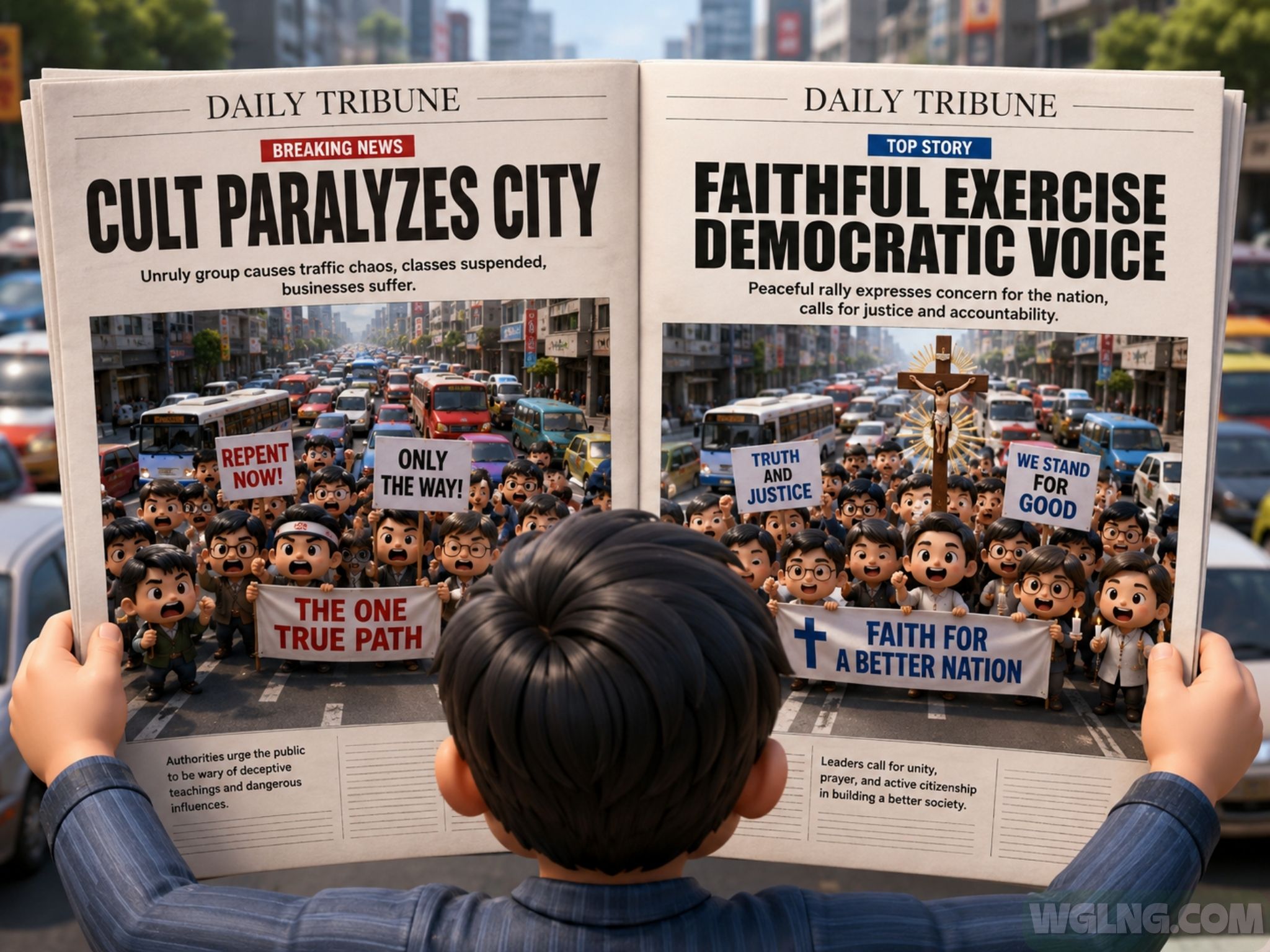
It is amusing, in the bleakest possible way, when Catholic-dominated Philippines and its Church-deferential media class casually brand other religions as “cults” the moment members of those groups stage political protests that disrupt traffic, classes, work, and business.
But when Catholics do the same thing—particularly when bishops themselves urge the faithful to take their politics to the streets—the tone suddenly changes. The disruption becomes civic duty. The inconvenience becomes moral witness. The spectacle becomes democracy in action. The same media that sneer at one religious crowd often turn reverent, even sycophantic, when the procession carries the more familiar cross.
The hypocrisy is not subtle. It is merely normalized.
Most religions preach some version of mercy, restraint, and humility before judgment. Yet history and daily life keep showing how easily those teachings are discarded when the target belongs to another church, another sect, another tribe. In the Philippines, even Catholics can turn vicious toward fellow Catholics who vote differently, worship differently, or question the wrong authority. The contempt only deepens when the other side belongs to a different denomination altogether.
This is why the sanctimony rings hollow. Religion is often sold as a civilizing force, a moral anchor, a path toward compassion. But too often, it becomes another uniform for tribal arrogance. It does not soften judgment; it blesses it. Too often, it does not make people kinder; it merely gives them holier words for their cruelty.
And when every side believes “heaven” has endorsed its prejudice, the world does not become more moral. It only becomes more comfortable mistaking prejudice for righteousness.