
The rush to claim Jordan Clarkson’s NBA championship as a Philippine triumph says more about Filipinos' need for reflected glory than it does about nationality.

I’ll admit it—I don’t really feel proud when I see how Filipinos celebrate Jordan Clarkson’s NBA championship with the New York Knicks. It kind of embarrasses me more than anything.

And look, it’s not that Clarkson doesn’t deserve praise. Winning an NBA title is a huge deal, and he actually contributed to it. What gets under my skin is this habit many Filipinos have of hunting for Filipino roots in any successful person’s family tree, then treating that person’s win like it’s our own national victory.

Now Clarkson is being called the “first Pinoy to win an NBA ring.” Local sports media repeats it so often that people act like it’s an undeniable fact. Some are even suggesting Congress should officially recognize him—because apparently, if there’s even a drop of Filipino blood in someone’s veins, the whole country needs to issue a formal thank you.

This is where things get messy.

Jordan Clarkson is American. He was born and raised in the U.S., learned basketball there, played college ball there, and built his NBA career there. The Philippines didn’t discover him, train him, or create the opportunities that led to his ring.

Yes, his Filipino ancestry is real. Let’s be clear: His maternal grandmother, Marcelina Tullao Kingsolver, was from Pampanga. His mom is part Filipino, and Clarkson is about one-quarter Filipino by ancestry.

He’s embraced that heritage, gotten a Philippine passport, and played for Gilas Pilipinas a few times. That’s real, and it shouldn’t be dismissed.

But we also shouldn’t blow it out of proportion.

FIBA classifies Clarkson as a naturalized player for the Philippines because of their eligibility rules—especially around when he got his passport. That’s a sporting classification, not a statement on whether he has a real connection to the country. Although he clearly does.

The most honest way to put it: Clarkson is the first Filipino-American—or the first NBA champion of Filipino descent—to win a ring. That’s accurate, specific, and still worth celebrating.

What gets ridiculous is when we drop all the qualifiers and start presenting him as simply a Filipino athlete whose championship belongs to the Philippines. That’s just soaking in someone else’s success. Turning their achievement into our own, just by repeating it enough times.

The hysterical Philippine sports media seems dead set on force-feeding this narrative. Maybe it’s harmless. Maybe people just want something to be happy about. And honestly, who am I to complain? Just some random person shouting into the void, easily drowned out by the roar of Pinoy pride.

Still, words should mean something. Jordan Clarkson is an American basketball player with genuine Filipino roots. He’s represented the Philippines, and that bond is real. But his NBA championship with the Knicks is his. Not yours.

Categories Cultural Alienation, Everyday Absurdity

NewJeans’ case raises a harder question beyond contract law: what happens when a company can keep artists as hostages without truly moving them forward?
NewJeans’ case raises a harder question beyond contract law: what happens when a company can keep artists as hostages without truly moving them forward? (L-R: Danielle, Minji, Hyein, Hanni, and Haerin. Photo credits: CNN Style)

NewJeans (Danielle, Minji, Hyein, Hanni, and Haerin) is the only Korean girl group I genuinely like.

That is not meant as a sweeping insult against the Korean music industry. Obviously, that industry knows how to produce polished performers, massive fandoms, and global pop moments. But NewJeans felt different to me from the start. Their music, styling, pacing, visual identity, and overall packaging seemed superior to what the industry usually offers. They did not feel like another interchangeable product from the machine. They had a distinct atmosphere. Their songs had restraint — a rare confidence in not overproducing every moment. Their image had clarity. Their appeal was not built on noise, spectacle, or forced intensity. They felt fresh, confident, and unusually well-formed.

That is why the HYBE/ADOR conflict has been so frustrating to watch from the outside.

As I understand it, the legal fight has so far favored HYBE/ADOR. The court recognized the continuing validity of NewJeans’ exclusive contracts, effectively preventing the members from walking away and operating freely outside ADOR. Attempts to function independently, including under a different name or structure, were blocked. Later developments involving Danielle further complicated the picture, with ADOR moving against her and pursuing damages connected to the dispute. In practical terms, HYBE/ADOR won the legal right to keep control over NewJeans and to enforce the contracts that reportedly run until 2029.

But legality is not the same thing as moral cleanliness.

My opinion is simple: HYBE/ADOR should release NewJeans and let them continue their careers elsewhere. If the company no longer has the creative environment, trust, or willingness to develop NewJeans properly, then keeping them under contract begins to look less like management and more like containment. It may be legally defensible. But from the outside, it feels like a hostage career.

Of course, HYBE can say it is only protecting valid contracts. It can say no company would willingly let a top act walk away. It can say the members, Min Hee-jin, and the public conflict damaged the working relationship. Fair enough. But NewJeans was not a failed experiment. NewJeans was one of the biggest, most distinctive, and most commercially promising acts in HYBE’s own backyard. If the group is now being kept inactive or reduced to a legal asset rather than a living musical act, then the question becomes unavoidable: what exactly is HYBE protecting?

The darker reading is not that HYBE’s intent can be proven from the outside. It cannot. But whatever HYBE/ADOR’s intent, the outcome can look like corporate containment. The members are bound by valid contracts, prevented from fully operating elsewhere, and at risk of losing the very career momentum the company claims to be protecting. That perception becomes even harder to shake when NewJeans was not merely another act in the building, but a group whose success was closely associated with Min Hee-jin and whose rise may have complicated the internal hierarchy of HYBE’s own girl-group ecosystem.

There is also a gendered power imbalance here that should not be ignored. (Oh, who are we kidding. Let’s just call a spade a spade - the deeply-ingrained Korean misogyny.) We do not need to read anyone’s mind to see its shape. On one side are powerful male executives with money, lawyers, time, and institutional control. On the other are young female artists and a female creative executive whose success disrupted the usual hierarchy. The men with the lawyers and the corporate machinery can wait. The young women whose careers are being frozen cannot. Their youth, momentum, visibility, and cultural timing are perishable.

That is what makes the 2029 timeline so troubling. In pop music, four or five years is not a pause. It can be an extinction event. NewJeans’ 2022–2024 success was built on freshness, timing, sound, styling, and a rare creative chemistry. By 2029, the girls may still have talent, beauty, and loyal fans. But the cultural moment that made NewJeans feel inevitable may be gone.

Yet, I still cling to that form of future reassembly: all five members free, reunited, and possibly working again with the creative people who shaped their original success. Maybe that could revive the spirit of NewJeans, even if the name itself is trapped behind corporate ownership.

But that is a long way off. And by then, the question may no longer be whether NewJeans can win in court.

It may be whether there is still enough of NewJeans left to save.

Related Links:


Categories The Entertainment Margins

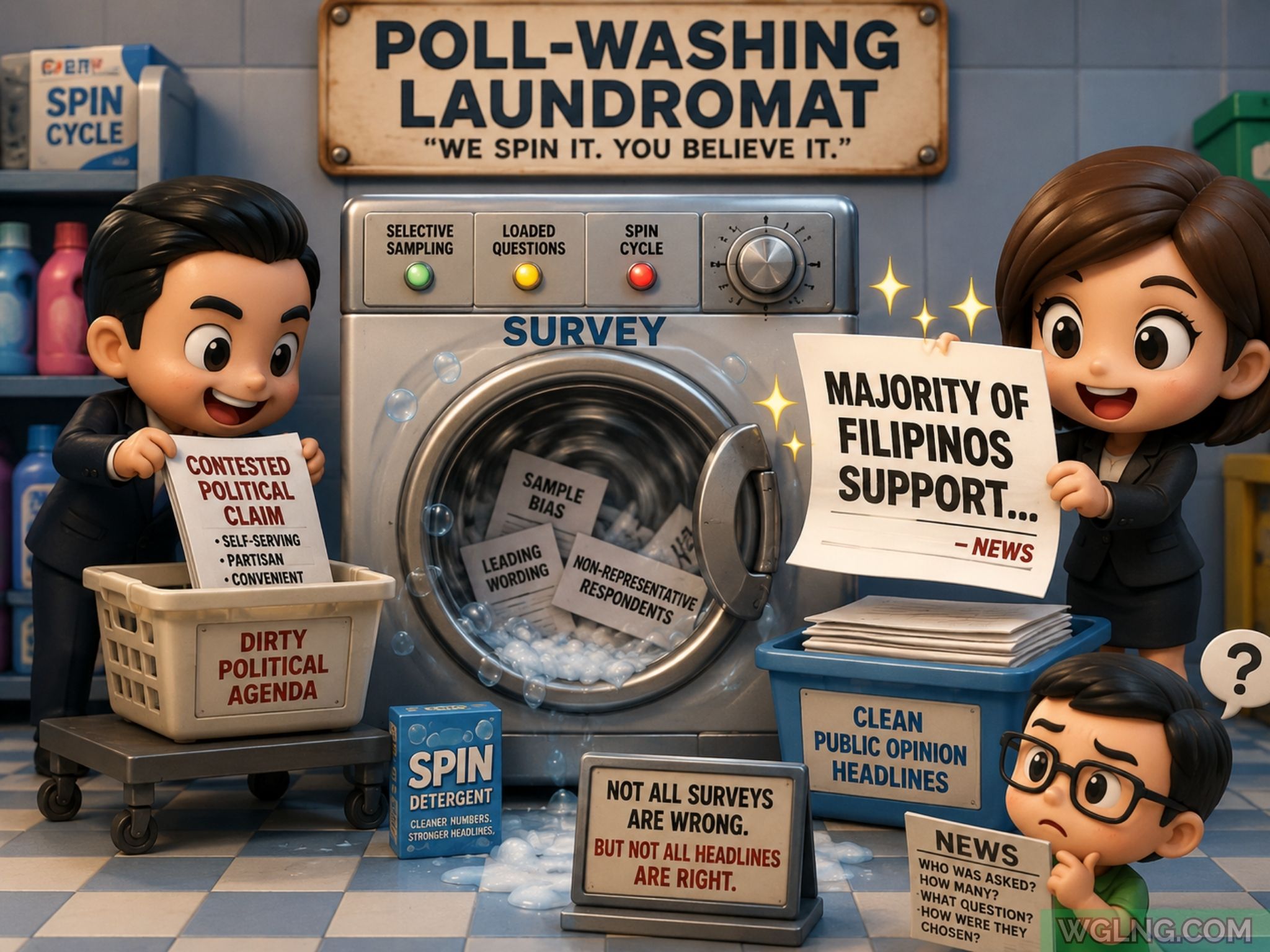
When reporting frames a contested political claim as public consensus, readers deserve to ask who is really speaking.

I have no interest in joining the latest round of political hair-pulling over who should sit where in the Philippine Senate. The factions can argue over titles, chairs, and alliances all they want. That is their chosen theater.

What bothers me is how easily some reports try to make that theater look like public consensus.

When a headline says a “majority of Filipinos” support a politician’s leadership role, it sounds big. It sounds settled. It sounds as if the country has already spoken. But as an ordinary reader, I think we are allowed to ask a few basic questions before accepting that kind of claim.

Who were asked? How many were asked? How were they chosen? What exactly was the question? Were the respondents really a fair picture of the country, or just people reached by a particular polling method? These are not questions only experts should be allowed to raise. They are common-sense questions.

And this should apply no matter which side benefits from the headline. A survey should not become “the voice of the people” just because it is useful to one camp today. Tomorrow, the same shortcut can be used by the other camp.

That is my frustration. The problem is not only the survey. It is the way the reporting frames it, as if a complicated political fight has suddenly been blessed by public opinion.

Sometimes, the headline does not inform us. It herds us.


Categories Partisan Hypocrisy, Procedural Farce

The Senate’s current drama shows how precedent and procedure can be twisted into a performance of self-interest.
The Philippine Senate’s current drama shows how precedent and procedure can be twisted into a performance of self-interest.

How far will educated, powerful people go just to protect their interests? Apparently, very far.

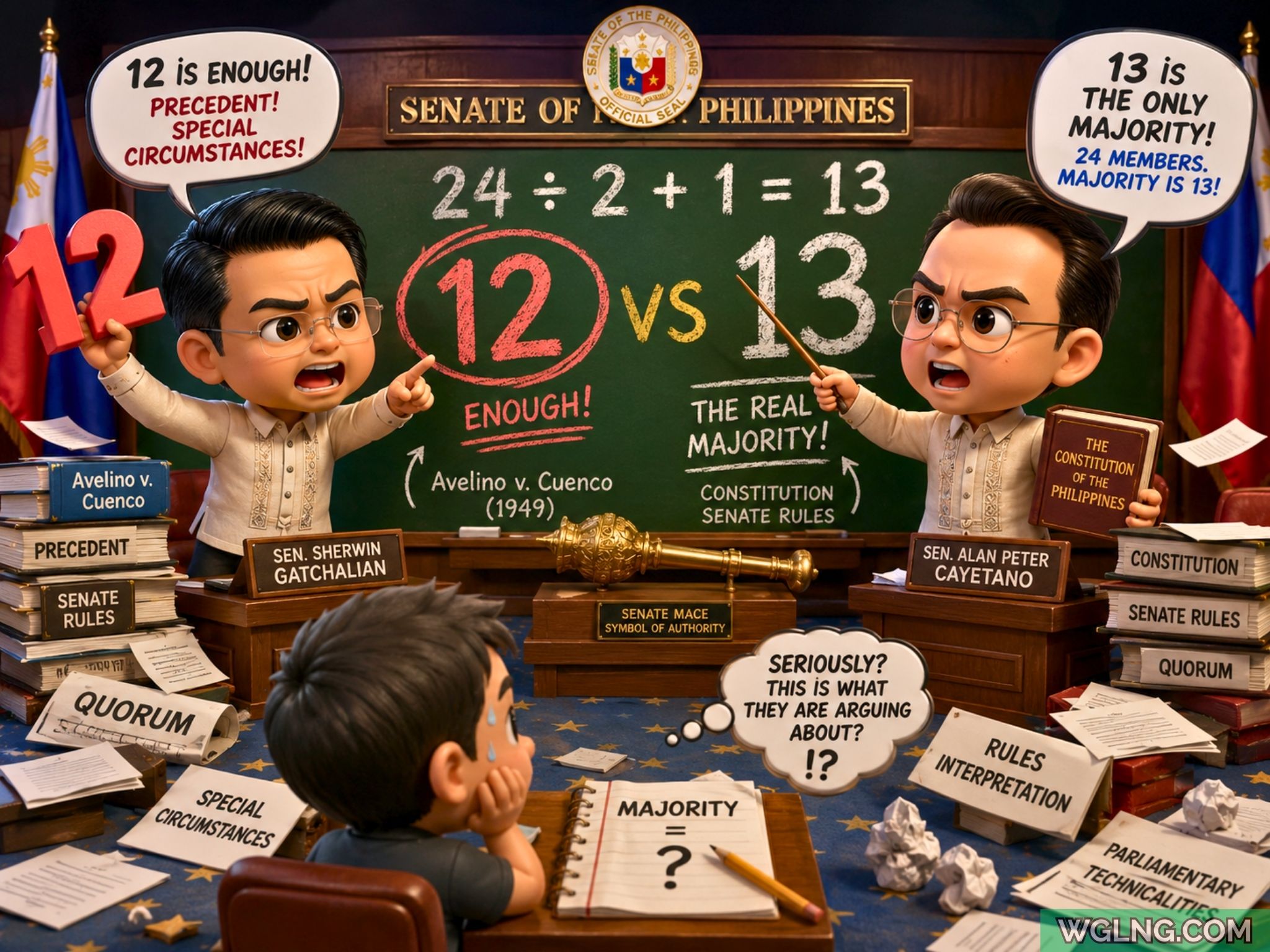
Far enough to turn a question of numbers into a constitutional drama. Far enough to make the public sit through serious-sounding arguments over whether 12 can somehow function like 13, whether absence changes the meaning of majority, and whether a Supreme Court case from 1949 can suddenly become useful again at exactly the right political moment.

That is where we are with this latest Senate mess.

A 24-member chamber is now arguing over whether 12 senators can validly act as the majority. One side points to Avelino v. Cuenco and says there is precedent for it under special circumstances. The other side says this should not be complicated: if there are 24 senators, then the majority is 13.

Both sides can sound clever, of course. They can cite rules, precedents, cases, traditions, and principles. They can make the whole thing sound noble if they try hard enough.

But from the outside, it looks less like a defense of constitutional order and more like power politics wearing a lawyer’s coat.

That is the thing about politics. Self-interest is almost never introduced as self-interest. It gets a nicer name. Institutional reform. Respect for precedent. Fidelity to the rules. Defense of the Senate. Protection of democracy. Pick one.

And maybe there are real legal questions somewhere in all that. I am not dismissing that entirely. But it is hard not to see the simpler fight underneath: who controls the floor, who controls the committees, who controls the agenda, and who gets the better position for the next political battle.

If this feels absurd, it is not even new.

Philippine Senate history has already given us the almost cartoonish image of politicians fighting over the Senate mace.

The mace is supposed to be a symbol of institutional authority. A dignified object. A ceremonial marker that the chamber is properly constituted and ready to act. But in the middle of a power struggle, even that can become a prop. At one point in our political history, control of the mace became entangled with the question of who had the legitimate Senate majority.

Just think about that for a moment.

Grown adults. Educated officials. Powerful people. Treating a ceremonial object as if holding it could help settle who had the real authority in the chamber.

It would be funny if it were not so embarrassing. It is 2026 and nothing has changed.

But maybe that is the calculation. When power is the prize, embarrassment becomes bearable. Looking ridiculous becomes acceptable. Public ridicule becomes just another cost of doing business. Loyalists will defend them. Allies will explain things away. The public will eventually get tired, or distracted, or overwhelmed by the next scandal.

And in the meantime, the institution takes another hit.

Every twisted argument, every procedural ambush, every walkout, every sudden appeal to principle teaches the public the same ugly lesson: rules look sacred only when they are useful. Once they become inconvenient, even “great minds” can find a way to bend them.

That is the most frustrating part. They do not always look and act stupid because they are stupid. They look and act stupid because they think YOU are.


Categories Civic Exhaustion, Institutional Rot

When Ya Kun Kaya Toast management already knows about a pest problem, continuing business as usual feels like the real infestation.
When management already knows about a pest problem, continuing business as usual feels like the real infestation.

My wife and I had to move tables at a Quezon City branch of a popular Singaporean restaurant chain because small cockroaches were coming out from behind the wall cladding.

Not the huge flying kind, thankfully. But still: cockroaches.

We first sat beside the wall, which turned out to be a bad idea. The roaches seemed to be nesting behind the decorative wall panels, occasionally making their little surprise appearances near our table. So we moved.

The next table wasn’t much better. They appeared to be in more than one area.

I brought it up to two different staff members.

The lady at the counter listened intently, smiled politely, and then went back to what she was doing as if I had just commented on the weather.

The man in the kitchen at least gave a useful answer after I returned my food tray. He told us the mall admin already knew about the pest issue and that treatment was scheduled for the following week. Management, he said, was aware and on top of it.

That was good to know, I suppose. But it also made the situation feel stranger.

If management and mall admin already knew there was a pest issue serious enough to require treatment, why was the restaurant still operating as if nothing was wrong?

In a properly run food establishment, this should have been treated as an urgent health issue, not something customers had to sit beside until next week’s scheduled pest control.

I get that pests can happen, especially in food establishments inside busy malls. What I don’t understand is the calmness around it. Not alarm. Not urgency. Just the quiet confidence of people waiting for “next week” while customers are eating beside the problem today.

Maybe that is what bothered me most. Not just the cockroaches. But the casual way the situation was handled.


Categories Consumer Disenchantment, Public Nuisance Studies