
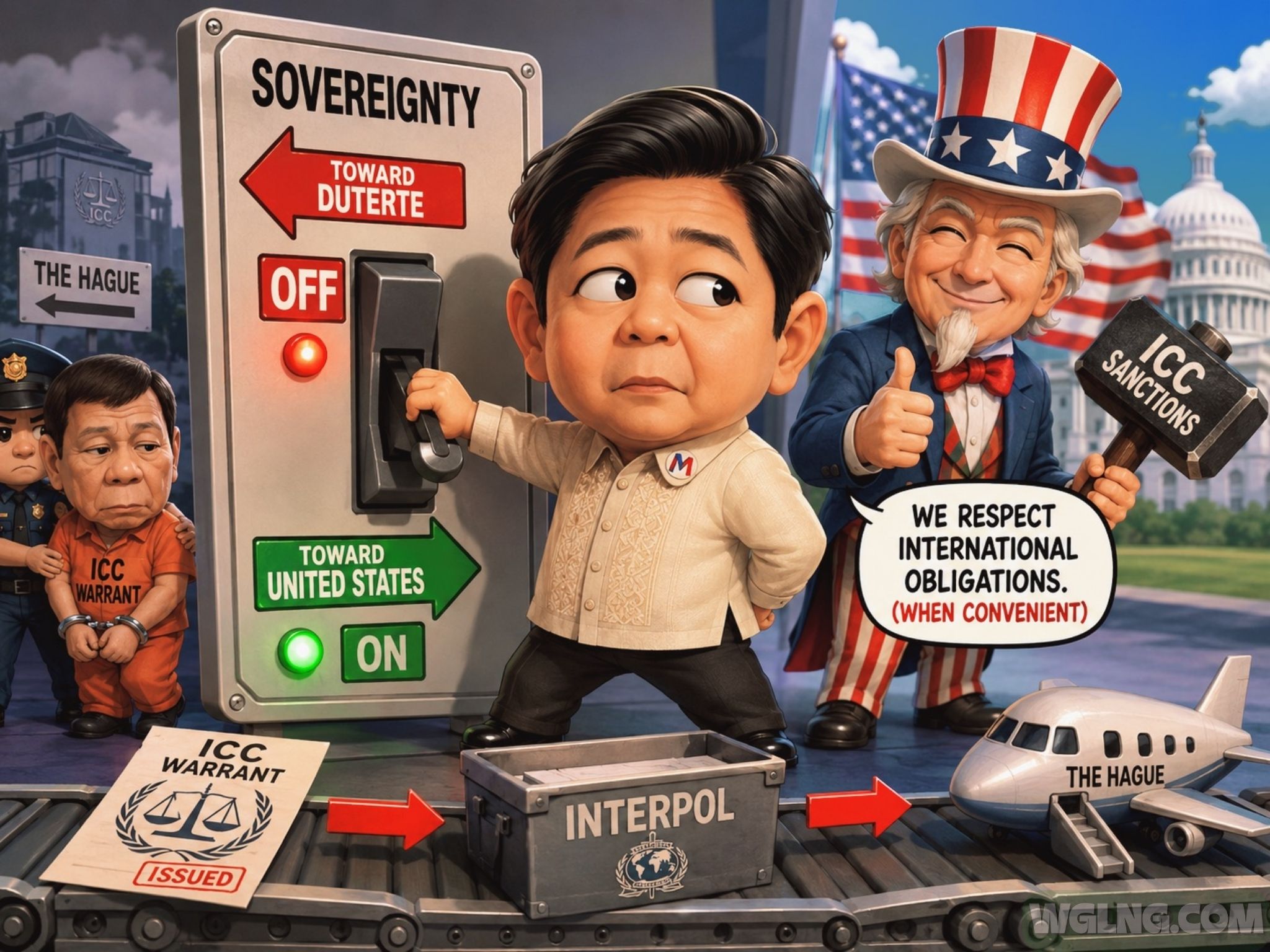
The United States now wants to cripple the International Criminal Court, denouncing it as a threat to national sovereignty whenever it investigates Americans or close U.S. allies.
Will Philippine President Marcos defend the institution his government found useful when Rodrigo Duterte was arrested and sent to The Hague?
Do not expect it.
The Philippines withdrew from the ICC in 2019, but the Court maintains jurisdiction over alleged crimes committed while the country was still a member. Marcos’s government nevertheless insisted that Duterte’s arrest was carried out through Interpol, not as formal cooperation with the ICC.
That distinction may satisfy government lawyers. Politically, it changes little.
Marcos need not endorse every ICC decision. But after using Interpol cooperation to enforce an ICC warrant while insisting that the Court no longer had authority over the Philippines, his government cannot credibly remain silent while Washington tries to disable the institution altogether.
If Manila now avoids criticizing the United States, the message will be clear: sovereignty is sacred when it protects those in power, negotiable when it removes a rival, and disposable when Washington objects.
Under Marcos, principle appears to end where political convenience and American approval begin.