
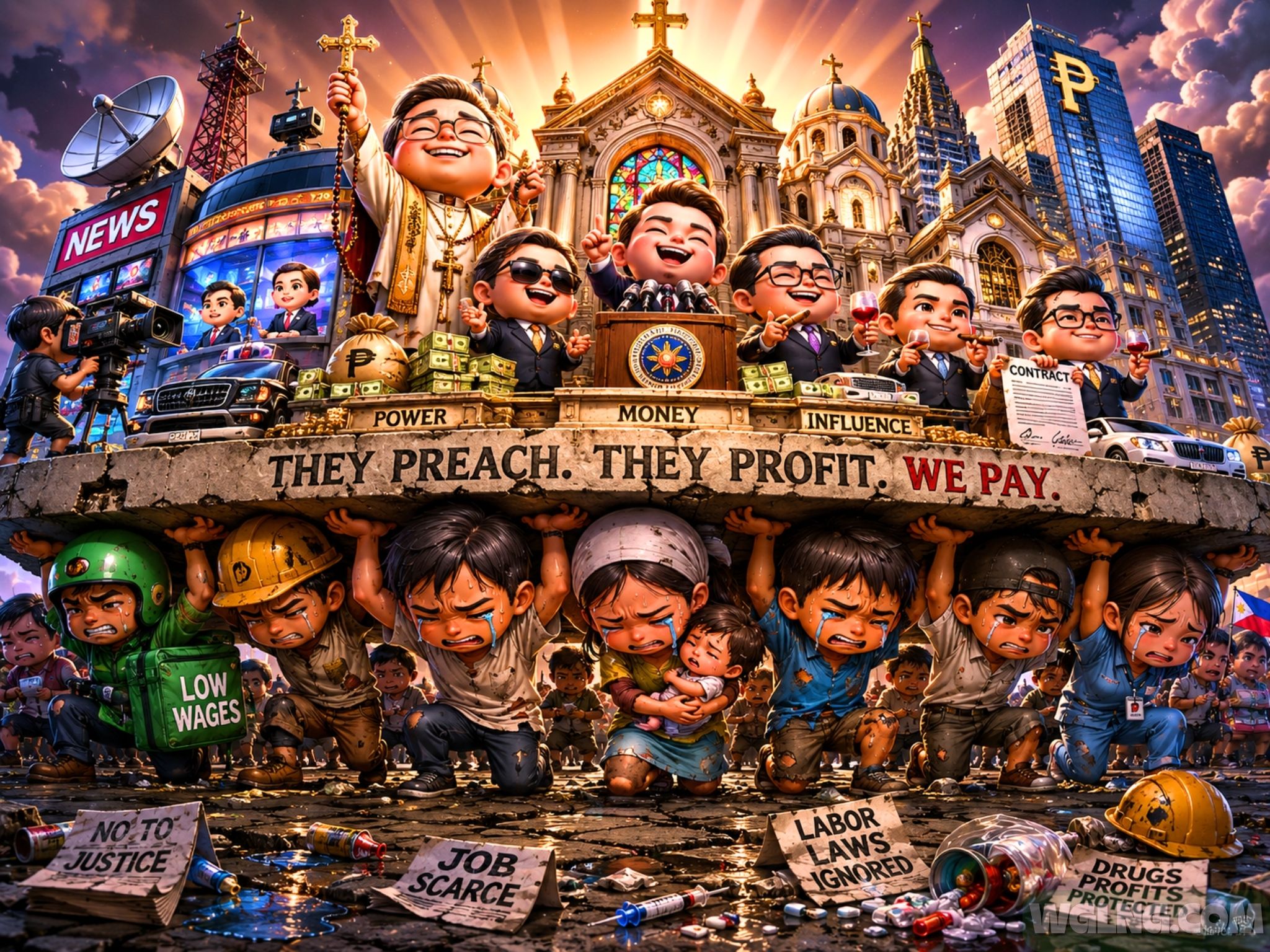
There is a cruel rhythm to Philippine society, and it has played for so long that many have mistaken it for normal life.
Every election season, the poor are discovered again. They become statistics, campaign backdrops, slogans, song-and-dance beneficiaries, proof that a candidate “understands the people.” Their hands are shaken, their children are kissed, their neighborhoods are entered by cameras and convoys. Then the votes are counted, the lights are packed away, and the same people return to the same lives: underpaid, overworked, underprotected, overpoliced, and endlessly lectured by people who have never had to choose between food, rent, medicine, and school expenses.
The ugly truth is that Philippine society has never been seriously designed to uplift the masses. It has been designed to manage them.
Piety as Costume
This is especially grotesque in a country that wears Catholic piety so proudly. The language of compassion is everywhere. Politicians attend Mass, quote Scripture, kiss religious icons, pose with bishops, and invoke God as if public virtue can be performed by merely being photographed in church. But the same society that kneels so visibly before altars often stands coldly before the suffering of the poor.
Religion, in this arrangement, does not soften power. Too often, it decorates it.
The problem is not faith itself. The problem is the way public piety becomes a costume for people whose actions are anything but "Christian". Some of the greediest, most ruthless, and most self-protective figures in society know exactly how to look devout. They know when to bow their heads, when to release a prayerful statement, when to appear at the right cathedral, and when to speak of mercy in public while defending systems that deny mercy to millions.
That is what makes the hypocrisy more sinister. Cruelty without religion is already ugly. Cruelty wrapped in piety becomes obscene.
Media Managing the Masses
The poor are needed as workers, consumers, voters, servants, drivers, guards, clerks, call center agents, riders, helpers, and warm bodies in political rallies. But they are rarely treated as citizens whose welfare should be the organizing principle of government. In theory, democracy gives them power. In practice, the country’s political and economic machinery is built to make sure that power is diluted, redirected, or bought back at the cheapest possible price.
And standing guard over this arrangement is a media ecosystem largely shaped by the interests, worldview, and social anxieties of the comfortable classes.
Whenever a political figure even appears to speak directly to the frustrations of the poor, the machinery starts humming. The candidate is not examined merely on competence or policy. He or she is processed through a moral filter controlled by people who already benefit from the current order. The poor may see someone who speaks their language, recognizes their anger, and promises disruption. The establishment often sees a threat to etiquette, investment confidence, elite consensus, and the polite illusion that the system only needs minor reforms.
So the candidate is flattened into a caricature. Crude. Dangerous. Uneducated. Populist. Dictatorial. Embarrassing. Unfit for polite society.
This does not mean every so-called champion of the poor is sincere. Many are frauds. Some exploit mass resentment for personal power. But it is striking how quickly elite opinion mobilizes against anyone who threatens to disturb the old hierarchy, while remaining remarkably patient with those who preserve it with better manners, cleaner English, and a more acceptable churchgoing face.
The media’s power is not simply in what it reports. It is in what it chooses to emphasize, what it minimizes, whom it humanizes, whom it mocks, and whose suffering is treated as urgent. A stock market tremor can become a national emergency. A business owner’s complaint can become a policy discussion. But the daily humiliation of workers, commuters, contractual employees, informal settlers, and minimum-wage earners is treated as background noise.
Selective Morality and the Drug Trade
The drug problem follows the same pattern of selective concern.
Public discussion often focuses on the poor communities where drugs are sold, used, and policed. That is where the cameras go. That is where the raids happen. That is where the mugshots come from. But everyone knows that illegal drugs do not move through society on the strength of street-level users alone. The trade survives because money protects it, demand sustains it, and influence shields it.
And yet the country rarely appears interested in asking uncomfortable questions about upper-class consumption, party circuits, private subdivisions, exclusive clubs, expensive schools, luxury nightlife, and the well-connected networks where illegal drugs can circulate with far less fear of consequence. The poor are treated as the face of the drug problem because they are easier to arrest, easier to shame, and easier to discard. The powerful, when implicated at all, are often treated as troubled individuals, victims of pressure, or names too delicate to say out loud.
This is another place where public morality becomes suspiciously selective. The same society that loudly condemns vice among the poor often becomes quiet, careful, and forgiving when the alleged vice belongs to someone rich enough, connected enough, or respectable enough to deserve discretion.
Cheap Labor, Holy Words
Then there is labor—the great national hypocrisy.
The Philippines loves to praise workers. It calls them heroes when they leave the country. It calls them resilient when they are underpaid. It calls them family when companies need loyalty. But when workers ask for wages that can actually sustain a family, regular employment, humane hours, benefits, security of tenure, and respect for labor laws, the praise suddenly becomes a lecture on competitiveness.
Businesses complain about costs. Managers complain about entitlement. Middle-class consumers complain when prices rise. Politicians make speeches about dignity. Executives talk about values. Owners thank God for blessings. And the worker is expected to absorb the sacrifice again.
It is not only the giant oligarchic firms that benefit from this culture. Smaller companies, subcontractors, agencies, family businesses, and middle-class entrepreneurs often reproduce the same abuses on a smaller scale. Delayed pay. Forced overtime. Fake “independent contractor” arrangements. Endless probation, a.k.a. the "5-5-5" scheme. No proper benefits. No real grievance process. Workers treated as disposable because there is always someone poorer, more desperate, and more afraid waiting outside.
The result is a country where the law exists beautifully on paper and weakly in practice. Labor rights become decorations. Minimum wages become survival jokes. Enforcement becomes negotiable. And dignity becomes something workers are told to earn after they have already given their health, time, and youth to employers who speak of “family culture” while cutting every possible corner.
This is why the masses remain trapped. Not because Filipinos are lazy. Not because the poor are ignorant. Not because they vote wrongly, as the comfortable classes love to say. They remain trapped because too many institutions are invested in keeping them there.
The oligarchy needs cheap labor. Politicians need dependent voters. Media needs narratives that do not offend ownership. Businesses need weak enforcement. The drug economy needs protected consumers and expendable fall guys. The middle class needs someone below them to blame, underpay, and feel superior to. And religion, instead of challenging this arrangement, is too often used to bless it, soften it, excuse it, or make its beneficiaries look morally upright.
So no, Philippine society will not suddenly wake up and look after the welfare of the masses. Not while the people who profit from the current arrangement are also the ones shaping the conversation, funding the campaigns, owning the platforms, influencing the laws, defining respectability, and occupying the front pews.
The poor are not forgotten.
They are remembered exactly when they are useful.