
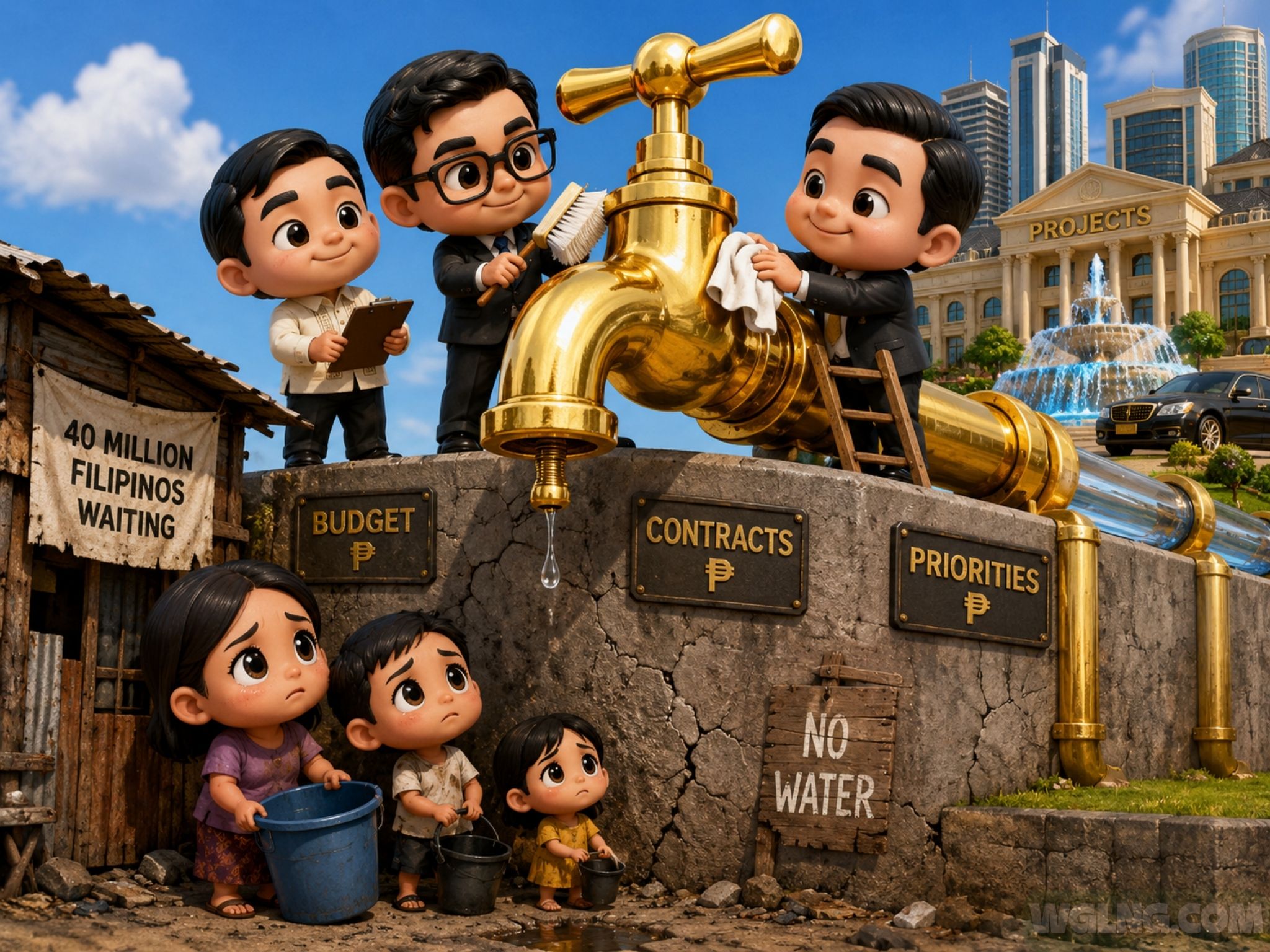
I came across the Jarius Bondoc piece about the looming water shortage, and my first reaction was shock.
But maybe “shock” isn’t quite right. In the Philippines, maybe the real surprise isn’t that a basic necessity is being mismanaged. Maybe it’s that anyone still acts surprised when the warning signs have been there for years.
A Crisis Hiding in Plain Sight
The numbers alone seem pretty alarming. According to the Presidential Communications Office in 2024, at least 40 million Filipinos don’t have access to fresh or potable water. President Ferdinand Marcos Jr. was even quoted telling agencies to come up with a plan for those 40 million people—plus another 40 million without a guaranteed local water supply.
That doesn’t sound like a small service gap to me. It sounds like a national failure dressed up as an administrative problem.
The Philippine Statistics Authority’s 2024 APIS figures paint a more complicated picture: 98.4 percent of families had access to an “improved” drinking-water source, but only 53.1 percent had safely managed drinking water piped into their dwelling, yard, or plot that was always enough. More than half of families still got water from refilling stations, and 6.5 percent said they didn’t have enough drinking water at least once because it wasn’t available at the source.
So yes, a lot of households technically have “access.” But from what I understand, access can mean different things. It can mean clean water from a tap. Or it can mean buying water elsewhere, fetching it, waiting for it, or relying on a source that looks fine on paper but isn’t reliable day to day.
Too Many Agencies, Too Little Accountability
From what I’ve read, the deeper problem isn’t just that the Philippines lacks water. It’s that water governance has become a maze of agencies, overlapping roles, weak coordination, and delayed reforms.
A Senate Economic Planning Office policy brief warned that the country’s water resources are nearing critical limits because of watershed degradation, pollution, climate change, population growth, urbanization, and weak administration. It also said that water management involves more than 30 agencies, with no single central authority overseeing everything.
In simpler terms: everyone has a piece of the problem, so no one really owns the disaster.
Can the People Charge Officials?
This is where I think public anger could turn into legal and civic pressure.
If people want to hold officials accountable, from what I gather, the strongest case isn’t just “They failed to fix the water crisis.” That might be morally right, but legally too vague. The stronger case would be that specific officials had specific duties, received specific warnings, had access to specific powers, budgets, permits, plans, or contracts, and still didn’t act—or acted in ways that helped private interests over the public.
Under the Anti-Graft and Corrupt Practices Act, public officers can be held liable if they cause undue injury to the government or anyone else, or give a private party an unwarranted benefit through obvious partiality, clear bad faith, or gross inexcusable negligence. The same law covers government contracts that are clearly and grossly disadvantageous to the government.
That phrase—gross inexcusable negligence—seems key.
Not ordinary error. Not one bad decision. Not a missed memo. But negligence so serious it’s hard to excuse, especially when millions of people are being told to live with dry faucets, unreliable supply, expensive alternatives, or unsafe water.
What Citizens Can Do
From what I’ve researched, people don’t have to limit themselves to angry posts and calls for resignation.
They can ask for serious congressional and Senate investigations that demand actual documents—not just sound bites: project lists, budgets, contracts, concession agreements, water-source studies, delayed permits, local water-district records, audit findings, and procurement histories.
They can file complaints with the Ombudsman if there’s evidence of gross neglect, favoritism, questionable contracts, unused funds, or officials ignoring formal demands.
They can push the Commission on Audit to look at water-related projects the same way flood-control projects have been examined: who got the contracts, who was paid, what was completed, what failed, and who benefited.
They can pressure LGUs to share their local water plans, water-quality monitoring, supplier arrangements, and emergency preparations. If a mayor or governor can find money for tarpaulins, festivals, vehicles, and self-promotion, citizens can ask where the money is for water.
They can organize consumer complaints against concessionaires and water utilities when service obligations aren’t met. They can ask for hearings before regulators. They can question why rates rise faster than reliability improves.
And they can support creating a real water department or regulator with real authority—not another ceremonial office that mainly issues statements while people line up with buckets.
What Is Marcos Doing?
In 2023, the Marcos administration created the Water Resources Management Office under the DENR to try to harmonize water efforts and push for integrated water management. The office was also supposed to help create a Department of Water and/or a Water Regulatory Commission.
In 2024, Marcos also ordered agencies to focus on the 40 million underserved Filipinos without formal or assured water supply. That order, at least on paper, acknowledged how big the crisis is.
But recognition isn’t the same as rescue.
The hard question, for me, is whether these actions have actually produced water for the people who need it—or just produced another layer of government language. If 40 million Filipinos are still underserved, then maybe the public shouldn’t be satisfied with “we created an office” or “we ordered agencies to prepare a plan.”
A plan isn’t water.
A memorandum isn’t water.
A press conference isn’t water.
The Real Issue Is Priority
It seems to me that people should be asking for deadlines, budgets, named accountable officials, published progress reports, and consequences for failure. They should ask which communities will be served, when, by whom, at what cost, and through what projects.
Because when a country can afford billion-peso projects, political dynasties, campaign caravans, confidential funds, ceremonial launches, and endless ribbon-cuttings—but still can’t guarantee clean water to tens of millions of its own citizens—then maybe the issue isn’t just scarcity anymore.
Maybe it’s priority.
And if public officials had the power to act but chose delay, indifference, incompetence, or private gain, then maybe people shouldn’t just ask for explanations.
Maybe they should ask for accountability.
Sources/Footnotes
- Jarius Bondoc, “Water shortage imminent; agency in charge unconcerned” — Philstar, May 20, 2026 https://www.philstar.com/opinion/2026/05/20/2529131/water-shortage-imminent-agency-charge-unconcerned
- “Philippine gov’t to address lack of potable water access for 40 million Filipinos” — Xinhua / English News.cn, May 7, 2024 https://english.news.cn/asiapacific/20240507/fd18634bb01e4337a87400aec15ab543/c.html
- “Access to Basic Drinking Water Service Among Families Improved in 2024” — Philippine Statistics Authority, March 13, 2025 https://psa.gov.ph/content/access-basic-drinking-water-service-among-families-improved-2024
- “Quenching Policy Thirst: Reforming Water Governance in the Philippines” — Senate Economic Planning Office Policy Brief, May 2024 https://legacy.senate.gov.ph/publications/SEPO/PB_Quenching%20Policy%20Thirst%20-%20Reforming%20Water%20Governance%20in%20the%20Philippines_07May2024.pdf
- Republic Act No. 3019 — Anti-Graft and Corrupt Practices Act — Office of the Ombudsman https://www.ombudsman.gov.ph/docs/republicacts/Republic_Act_No_3019.pdf